Saudi Arabia’s push to modernize healthcare is helping AI move from research pilots into everyday drug development work. Market research describes growing demand for AI-driven, personalized drug discovery in the Kingdom, linked to increasingly complex disease profiles and improving diagnostic capabilities. Hospitals, research institutions, and pharmaceutical companies face pressure to accelerate drug development timelines, which is prompting adoption of AI strategies that aim to improve efficiency and outcomes. In the same context, government efforts to digitize healthcare, promote innovation in pharmaceutical research, and strengthen regulatory frameworks are also cited as factors stimulating adoption across both public and private health sectors.
Several sources quantify this momentum differently, which highlights how fast-moving and model-dependent this space can be. One report values the Saudi Arabia AI in Drug Discovery Market at USD 1.2 billion, based on a five-year historical analysis, and ties growth to AI integration in healthcare, government support, and demand for more efficient drug processes in major cities. It also identifies Riyadh, Jeddah, and Dammam as dominant hubs because of healthcare infrastructure, the presence of leading pharmaceutical companies, and initiatives aimed at fostering innovation. Another outlook estimates the country’s artificial intelligence in drug discovery market generated USD 4.2 million in revenue in 2025 and is expected to reach US$ 24.9 million by 2033, with a stated CAGR of 25.1%.
What’s Actually Changing in the Workflow
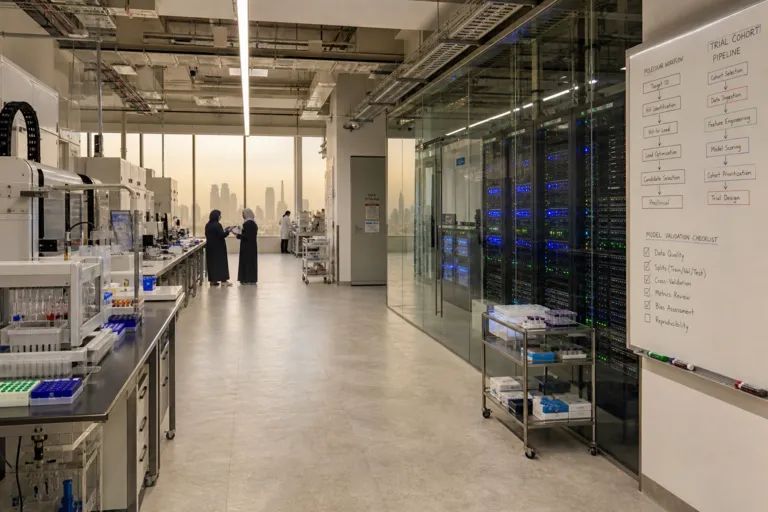
The practical change is a shift from linear lab cycles to data-driven loops that prioritize prediction, screening, and faster iteration. AI approaches cited for this work include deep learning models, natural language processing, predictive analytics, and generative algorithms. These methods are applied to target identification, lead optimization, drug repurposing, de novo drug designing, and preclinical testing. In Saudi market segmentation, common technology types include predictive analytics, machine learning models, natural language processing, and computer vision. On the application side, drug discovery leads, while clinical trials, patient stratification, and drug repurposing are also highlighted as key uses tied to the move toward more personalized medicine and more efficient development pipelines.
Clinical trials are another area where AI adoption is expected to become more visible. A Saudi-focused forecast states that, by future, 25% of clinical trials in Saudi Arabia will incorporate AI technologies to streamline patient recruitment and data analysis. The same source frames this shift as a pathway to reducing trial timelines and improving the accuracy of results, which can lift the overall drug development process. Separately, the CEO of the Saudi Food and Drug Authority (SFDA), Dr. Hisham Al-Jadhey, said AI shortens stages of drug development and discovery, as well as simulation of clinical trials, reducing timelines from years to months and significantly lowering costs. He also said AI can improve SFDA regulatory efficiency by strengthening data analysis for approvals.
Regulation and infrastructure are part of why Saudi AI drug discovery is moving from concept to implementation. Dr. Al-Jadhey noted that the SFDA launched the “SAIL” AI Lab last year, aiming to integrate the latest innovations and create a “digital twin” to support regulatory efforts and compare results for accuracy and efficiency. On the national policy side, a Saudi market report says the government implemented the National Strategy for Data and Artificial Intelligence (NSDAI) in 2023 to enhance AI use across sectors, including healthcare, with initiatives that promote R&D and provide funding and support for projects integrating AI into drug discovery. In a broader regional lens, the Middle East & Africa is described as nascent but showing early signals of interest, particularly in GCC countries such as Saudi Arabia and the UAE, where Vision 2030 and similar agendas are driving investment in life sciences and health technology infrastructure.
What is driving AI adoption in drug discovery in Saudi Arabia?
How large is Saudi Arabia’s AI in drug discovery market according to the sources?
How will AI affect clinical trials in Saudi Arabia?
What is the SFDA doing to support AI-enabled regulation?
What does the Saudi AI drug discovery stack include in practice?