Momentum in the Saudi orthopedic devices market is closely tied to system-level change. Governments in key countries including Saudi Arabia are focusing on healthcare modernization and infrastructure development, which supports the adoption of advanced orthopedic devices. Sources also point to growing public and private healthcare expenditure and improving medical insurance coverage, which together enhance access to procedures such as joint replacement, spinal surgeries, and trauma fixation. In this context, orthopedic devices span tools, implants, and instruments used to diagnose, prevent, and treat musculoskeletal disorders and injuries, with categories that include joint reconstruction implants, spinal devices, trauma fixation systems, and sports medicine solutions.
Disease burden is a core demand signal. In Saudi Arabia, a study published on ScienceDirect stated that musculoskeletal diseases were the second leading cause of disability-adjusted life years, and Grand View Research flags the high prevalence of such diseases as a primary driver for orthopedic devices growth in the Middle East & Africa. Regionally, the Middle East & Africa orthopedic devices market generated USD 1,852.4 million in revenue in 2023 and is expected to grow at a CAGR of 5.5% from 2024 to 2030. Within that same regional dataset, joint replacement/orthopedic implants were the largest revenue-generating product in 2023 and held a 41.78% revenue share.
Where Demand Concentrates: Public Trauma Volume vs Private Elective Complexity
Saudi care delivery patterns are reshaping which orthopedic products win. IndexBox describes demand as bifurcating along care-setting lines: high-volume, price-sensitive commodity products for trauma in public hospitals versus high-value, complex combination products for elective spine and joint preservation in private ASCs and specialty clinics. It also notes an accelerated shift to outpatient and ASC settings, driven by government healthcare transformation goals and private sector investment, with complex spinal fusions and joint preservation procedures migrating from inpatient settings to advanced ambulatory surgical centers. In public tertiary hospitals, procurement is described as being driven by formulary committees emphasizing cost-per-gram and proven safety profiles for commodity-like synthetics and allografts.
Product mix follows that split. In Saudi Arabia’s orthopedic regenerative segment, IndexBox lists synthetic bone graft substitutes (ceramics such as β-TCP and hydroxyapatite, polymers, and composites), allograft-based products (including demineralized bone matrix and structural allografts), and systems for harvesting and concentrating autograft such as bone marrow aspirate concentration (BMAC). It also cites osteoinductive growth factors such as bone morphogenetic proteins, cell-based therapies, hyaluronic acid and collagen-based products for visco-supplementation and soft tissue repair, and scaffolds for cartilage and soft tissue repair. Across the broader Middle East & Africa discussion, another source highlights demand for joint reconstruction implants (especially knee and hip), trauma fixation devices, spinal implants, and orthopedic braces, and points to rising acceptance of minimally invasive operations, including arthroscopy, minimally invasive complete joint replacement, and spine surgery.
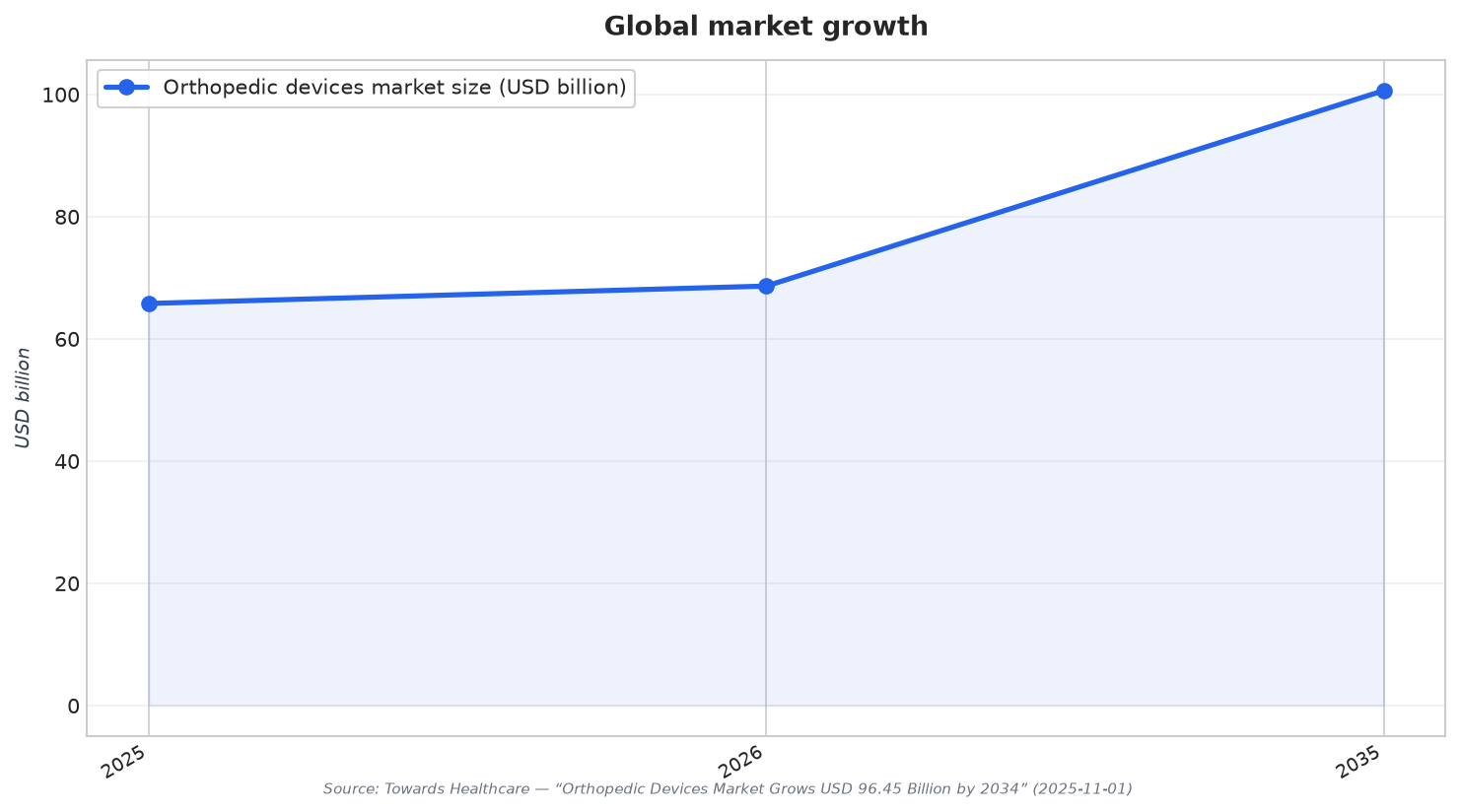
Saudi Arabia also sits inside a regional growth story with multiple measurement points. Market Data Forecast estimates the Middle East & Africa orthopedic devices market at USD 3.36 billion in 2024, rising to USD 3.51 billion in 2025, and reaching USD 5.03 billion by 2033, with a 4.59% CAGR from 2025 to 2033. The same report lists Saudi Arabia among the top contributors alongside the UAE, South Africa, Egypt, and Israel, citing higher healthcare spending, improving infrastructure, and greater access to orthopedic care. For manufacturers and providers, this creates a practical focus: align portfolios to high-volume trauma needs in public settings while building capabilities for elective spine, sports medicine, and joint preservation pathways that are increasingly serviced in private hospitals and ASCs.
What is driving growth in Saudi Arabia’s orthopedic devices demand?
How big is the Middle East & Africa orthopedic devices market in the sources?
Which segment led MEA orthopedic device revenue in 2023?
How is procurement and product adoption splitting across Saudi care settings?
What does the Saudi orthopedic devices market boom look like in practice across joints, spines, and trauma?