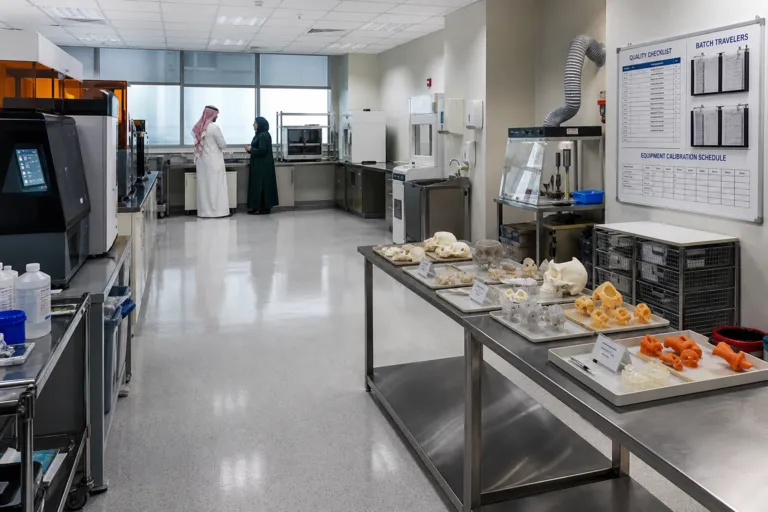
Saudi Arabia’s healthcare system is increasingly using additive manufacturing to create anatomical models, implants, prosthetics, and bioprinting scaffolds. In a Saudi Arabia-and-Egypt market definition, this work is described as layer-by-layer fabrication using polymers, metals, and even living cell suspensions, with typical layer resolutions ranging from 25 to 100 microns depending on the clinical application. The stated clinical aims are practical: reduce surgical time, improve patient outcomes, and enable distributed manufacturing of customized devices closer to the point of care. That “near-care” workflow is also supported by software and planning tools that connect imaging-based design to production of surgical guides and patient-specific devices.
Multiple market reports describe rapid expansion, but their scopes differ, so comparisons require care. One report focused on Saudi Arabia’s 3D printing medical devices market estimates USD 81.22 million in 2024 and projects USD 320.67 million by 2033, with a stated CAGR of 16.43% from 2025 to 2033. A separate report covering the combined Saudi Arabia-and-Egypt healthcare 3D printing market evaluates USD 16.24 million in 2025 and forecasts around USD 69.81 million by 2035, with a CAGR of 15.7% from 2026 to 2035. Another Saudi-specific study projects growth from USD 3.2 billion in 2025 to USD 9.4 billion by 2032, at approximately 16.5% CAGR. Because the definitions and coverage vary by source, the consistent signal is direction rather than a single definitive total.
Where Hospitals See Value First: Implants, Guides, and Dental Work
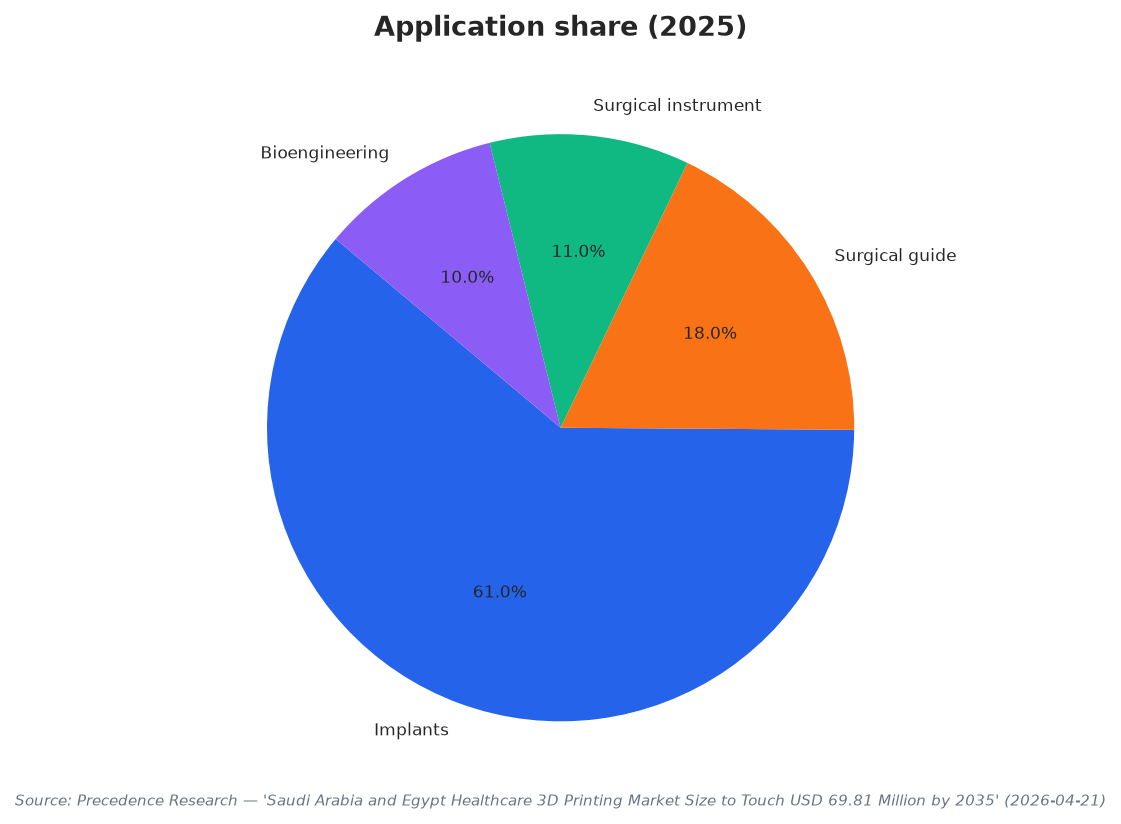
Demand clusters around patient-specific tools that fit into today’s clinical pathways. In 2025 application shares for the combined Saudi Arabia-and-Egypt healthcare 3D printing market, implants lead with 61%, followed by surgical guides at 18%, surgical instruments at 11%, and bioengineering at 10%. The same dataset shows technology shares led by photopolymerization at 36%, with laser beam melting at 29%, droplet deposition at 18%, and electron beam melting at 17%. Material shares in that source highlight polymers at 51%. In Saudi Arabia specifically, one market note highlights dental and orthopedic momentum and cites an estimated 1.8 million dental procedures performed annually, a workload that can pull demand toward customized dental implants and orthodontic devices.
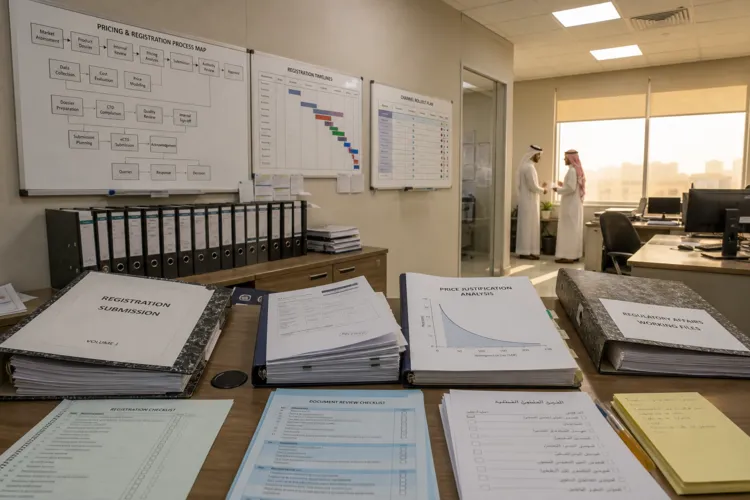
Regulation and quality systems are shaping how quickly new printers, materials, and workflows enter clinical practice. One analysis emphasizes the role of the Saudi Food and Drug Authority (SFDA) in enforcing medical device registration and quality management standards, and notes alignment with ISO 13485 and IEC 62304 frameworks to harmonize software-controlled medical device production with international benchmarks. Another passage describes tightening quality frameworks for patient-specific implants and the need to reconfigure software-controlled production workflows around those standards. On the manufacturing side, it also points to AI-driven topology optimization in Riyadh hospital clusters to reduce material waste in titanium orthopedic constructs, while describing a broader shift toward multi-material extrusion combined with AI-driven optimization.
Bioprinting is positioned as an emerging frontier, but the cited sources describe it more as fast-growing research and early clinical enablement than as a routine, mass-deployed service. In the Saudi Arabia-and-Egypt market view, bioprinting materials are described as the fastest-growing category as tissue engineering protocols mature in research institutions, and bioprinting scaffolds are included within the healthcare 3D printing scope. A Saudi-focused market overview also states that by 2032 the country will witness significant advancements in bioprinting, regenerative medicine, and personalized drug manufacturing, while researchers explore the possibility of printing human tissues and organs for transplantation. In this context, the keyword topic—Saudi 3D printing healthcare—reads as a practical story of near-term device production today, paired with a longer-term pipeline of bioengineering capabilities being built layer by layer.
What market figures are reported for Saudi Arabia’s 3D-printed medical devices segment?
Which applications dominate healthcare 3D printing in the Saudi Arabia-and-Egypt dataset?
What technologies lead in the 2025 Saudi Arabia-and-Egypt healthcare 3D printing split?
How is the SFDA described as influencing adoption in Saudi healthcare?
What is changing in Saudi 3D printing healthcare as bioprinting develops?