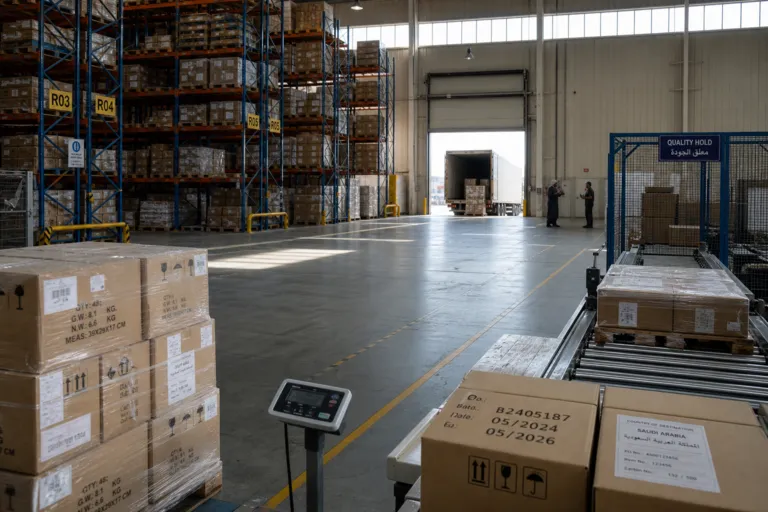
Saudi Arabia is building a larger, more capable medicines ecosystem at home. Future Market Insights values the Saudi Arabia pharmaceutical market at USD 11.7 Bn in 2026 and forecasts USD 22.9 Bn by 2036, implying a 6.3% CAGR from 2026 to 2036. In parallel, IMARC Group data cited by Vocal Media places the market at USD 9.60 Billion in 2025, with an estimate of USD 11.79 Billion by 2034 and a 2.30% CAGR from 2026 to 2034. Those outlooks differ, but both frame a market with expanding demand, which is a precondition for outward-looking production and higher export readiness.
Demand fundamentals matter because they shape what gets made locally and how consistently plants run. Prescription drugs dominate, holding a 64% share in 2025, according to IMARC data cited by Vocal Media. The same source ties this demand to chronic disease indicators from a 2024 National Health Survey: about 18.95% of adults reported at least one chronic condition, with diabetes at 9.1% and hypertension at 7.9%. An Elderly Survey 2025 counted approximately 1.7 million people aged 60 and above, representing 4.8% of the total population. Together, these signals point to sustained, repeat medicine use that can support predictable domestic volumes before manufacturers lean more aggressively into Saudi pharmaceutical exports.
Local Manufacturing Scale Is the Export Gatekeeper
Export ambition runs into a hard constraint: how much of the national medicine basket is actually made inside the Kingdom. Grand View Research states that only 30% of medications sold in Saudi Arabia are manufactured locally, and that the industry is primarily reliant on medicines imported from the U.S., Europe, China, and India. That import dependence can limit exportable surplus and expose manufacturers to external input risks. It also helps explain why shifting from domestic coverage to regional supply is not simply a marketing exercise. For exports to become a durable growth engine, local output and the reliability of upstream sourcing have to rise together.
Contract development and manufacturing can be one path to scale and credibility with partners. Grand View Research notes that Saudi Arabia accounted for 1.1% of the global pharmaceutical CDMO market in 2024. Within that CDMO view, API is identified as the largest segment with a revenue share of 81.39% in 2024. These figures do not, on their own, quantify export volumes. But they do indicate an industrial base with room to expand services and production depth. In parallel, Fitch Solutions says new trade data prompted revisions to Saudi Arabia’s pharmaceutical trade forecasts, with import growth outpacing exports and pointing to a widening trade deficit over the short term. Fitch also expects growing international partnerships, particularly involving Portugal-based and Jordan-based drugmakers, to support manufacturing ambitions under Vision 2030.
The near-term test for exporters is operational resilience under regional disruption. Fitch Solutions links escalating regional risks—including the US-Iran conflict and Houthi-Saudi tensions—to supply chain disruption and a weaker 2026 outlook, and it warns these dynamics could weigh on the pharmaceutical market outlook. In that context, “Made in KSA” export strategies will likely work best when they are tied to dependable distribution pathways and institutional demand anchors. Future Market Insights emphasizes that hospital pharmacies hold the leading channel position due to strong institutional dispensing across regulated therapy use, while pharmacy access expansion supports market expansion. Export growth can follow domestic strength, but only if manufacturing capacity and supply reliability keep pace with the Kingdom’s own rising need.
Can Saudi Arabia turn locally made medicines into a stronger export engine?
What demand signals support long-term production growth in Saudi Arabia?
What does Fitch Solutions say about imports versus exports in pharma trade?
How developed is Saudi Arabia’s pharmaceutical CDMO footprint?