Saudi Arabia’s nuclear medicine story is increasingly about capacity building, not just demand. One market outlook expects projected revenue of US$ 190.2 million by 2030, with an expected 11.6% CAGR from 2025 to 2030. The same source states the Saudi market generated USD 142.2 million in 2024 and is expected to reach USD 220.5 million by 2030, and that Saudi Arabia accounted for 0.6% of the global nuclear medicine market in 2024. Those figures frame how the Kingdom is positioning nuclear medicine as a practical health service and a platform for more advanced theranostic care pathways.
Licensing and facility readiness are central to scaling services safely, and they show up in real examples. In 2017, King Fahad Hospital in Jeddah received permission to practice nuclear medicine, and its diagnostic radiology department received a license from the National Center for Radiation Protection for the use of radioactive substances in medical diagnosis and treatment. At the market level, diagnostics was the largest segment in 2024, with a revenue share of 76.51%. That diagnostic base matters for theranostics because it anchors PET and SPECT workflows, clinical teams, and compliance routines that can later support the therapeutic side of nuclear medicine.
Theranostics and Radiopharmacy: From Isotope Supply to Clinical Delivery
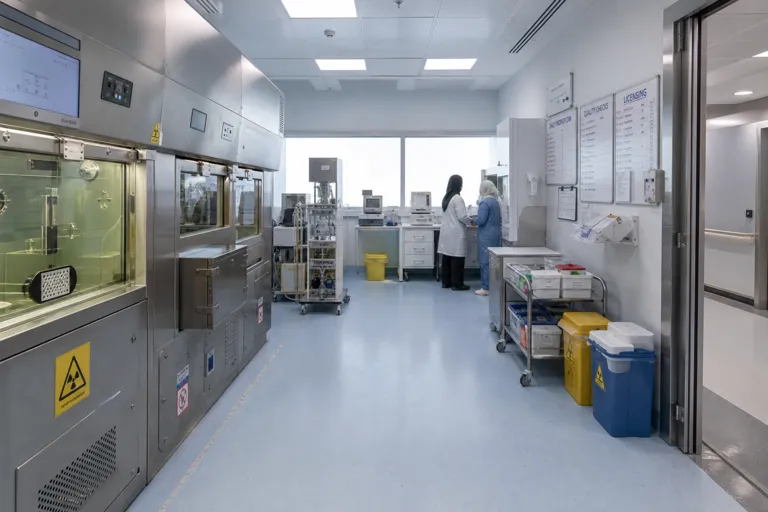
Theranostics depends on reliable isotopes, radiochemistry, and distribution discipline, and Saudi-focused commentary points directly to those building blocks. A Saudi Arabia beta-emitter radiopharmaceuticals market source describes expansion of nuclear medicine facilities, trained clinical teams, and theranostics centers, supported by investment in imaging technologies, staff training, and facility compliance. It also notes improvements in radioisotope production infrastructure, including generator systems, reactor output, and separation technologies, to enhance availability of key beta emitters in Saudi Arabia. It specifically highlights expanded capacity for Lu-177, Y-90, and I-131 as a way to reduce dependency on limited sources and support broader clinical programs.
Regional comparisons underline why local radiopharmacy capability is a strategic lever. One radiopharmaceutical market source states the UAE alone has over 25 advanced nuclear medicine facilities, and that Saudi Arabia accounts for nearly 40% of Middle East demand. The same source adds that the Middle East & Africa region contributes approximately 10% of the radiopharmaceutical market outlook, while the Middle East accounts for nearly 70% of that regional demand. It also reports oncology accounts for about 65% of radiopharmaceutical applications and that over 60% of new nuclear medicine developments combine diagnostic and therapeutic capabilities. For Saudi planners, those statements reinforce the logic of pairing diagnostic growth with therapeutic readiness.
Global market trajectories also support the Kingdom’s emphasis on supply-chain reliability and in-house production models. One report values the global radiopharmaceutical market at USD 7.47 billion in 2025 and projects USD 17.47 billion by 2034, with a 9.9% CAGR from 2026 to 2034, while North America held 42.6% market share in 2025. It also flags growing adoption of on-site cyclotron facilities to produce short-lived isotopes, noting benefits such as reduced dependence on external suppliers and fewer transportation-related delays. In this context, the saudi nuclear medicine market narrative increasingly centers on building the operational backbone—people, processes, and production—to deliver theranostics at scale.
What is the revenue outlook for Saudi Arabia’s nuclear medicine market by 2030?
How large is the diagnostics segment in Saudi Arabia’s nuclear medicine market?
What evidence shows nuclear medicine capacity building in Saudi Arabia?
Which beta-emitting isotopes are highlighted for expanded capacity in Saudi Arabia?
How is Saudi Arabia positioned within Middle East nuclear medicine demand?