
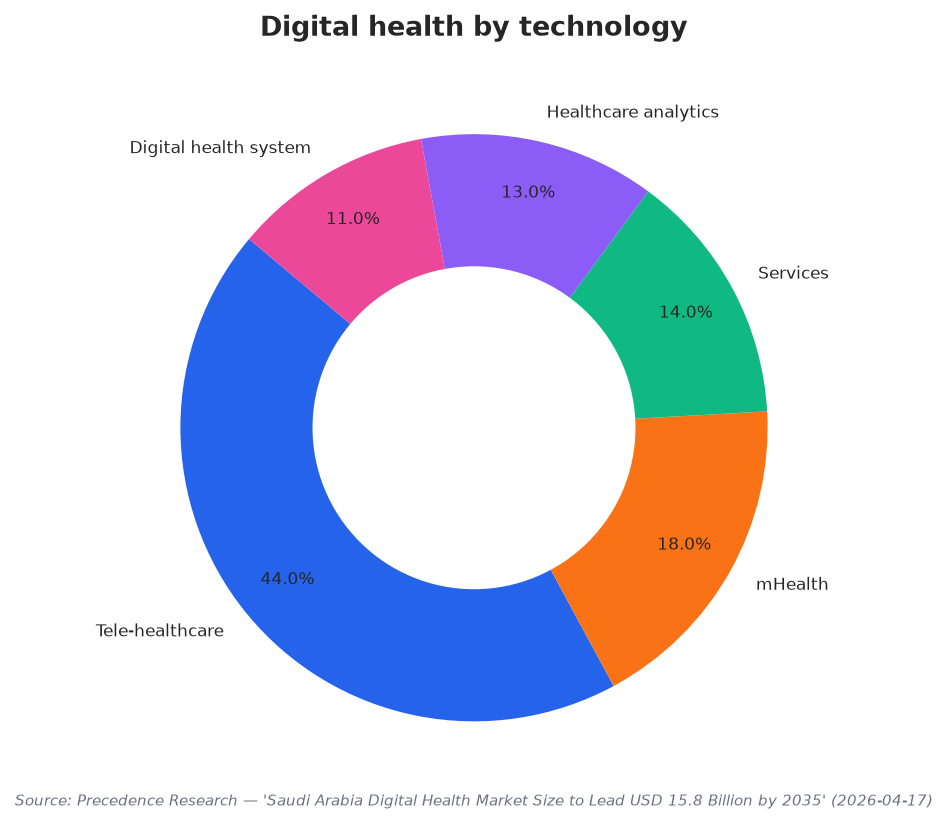
Saudi Arabia’s push toward “one record” care is increasingly framed around interoperability, not just digitization. Multiple market and survey signals point in the same direction: electronic health records (EHR), health information systems, and secure data sharing are becoming central to care delivery and health system management. Precedence Research estimates the Saudi Arabia digital health market at USD 2.81 billion in 2025 and projects it to reach around USD 15.8 billion by 2035, with a CAGR of 18.85% from 2026 to 2035. In the same 2025 market view, tele-healthcare leads technology share at 44%, while healthcare analytics holds 13%—two areas that depend on clean, connected data flows between settings.
That interoperability agenda shows up in what organizations buy and how they modernize. Nexdigm notes that EHR systems hold a dominant market share in KSA, driven by national hospital digitization initiatives, centralized patient data management requirements, and strong government support for health information interoperability across healthcare institutions. At the same time, Nexdigm highlights a practical barrier: many institutions still run legacy hospital information systems not designed for modern digital integration, creating compatibility and interoperability challenges when new platforms are introduced. This is why government hospitals—described as the backbone of the Saudi healthcare system—are positioned as leading adopters of integrated digital healthcare platforms that combine telemedicine services, digital medical records, and health analytics for operational efficiency and clinical decision support.
From Policy to Procurement: Turning Standards Into Shared Care
Policy is also shaping how data can move, and under what safeguards. Ken Research reports that in 2023 the Saudi government implemented the Health Data Law, which mandates secure handling and sharing of health data while ensuring patient privacy, with the stated aim to enhance data interoperability among healthcare providers and promote de-identified data use for research and public health initiatives. In that same report, the Saudi Arabia de-identified health data market is valued at USD 1.2 billion based on a five-year historical analysis, with growth linked to EHR expansion, AI integration, and a precision medicine focus, including activity in Riyadh, Jeddah, and Dammam. These dynamics make interoperability more than an IT preference; it becomes an operational requirement for compliant exchange and analytics-ready datasets.
Procurement research underscores how this shift is being operationalized through national programs and buying cycles. A July 30, 2026 Newswire release summarizing Black Book Research findings says “One Health Record” is accelerating national demand for enterprise records, shared-care interoperability, governed AI, cyber resilience, and measurable workflow returns through 2027. The study is based on responses from 128 Saudi healthcare IT leaders involved in technology selection, implementation, and modernization decisions. The report evaluates EHR platforms and hospital information systems across interoperability, NPHIES connectivity, clinical workflows, cybersecurity, privacy, implementation, local support, and long-term commercial sustainability. Together, those criteria position interoperability as a core procurement lens, not a secondary integration task.
The broader e-health trajectory adds context for where Saudi health data interoperability can have the biggest impact. Ken Research values the Saudi Arabia E Health Market at USD 1.3 billion based on a five-year historical analysis and states that, by future, over 70% of healthcare facilities are expected to adopt digital health solutions. The same source projects the telemedicine sector in Saudi Arabia to reach $1 billion by future, reflecting demand for remote consultations. Interoperability matters here because virtual care, analytics, and EHR standardization rise together: Ken Research also notes that the EHR segment dominates due to the need for efficient patient data management, supported by national programs to standardize and integrate EHRs across public and private facilities. In practice, “one record” becomes the mechanism that connects these digital services into coordinated care.
What is driving Saudi Arabia’s health data interoperability push?
What does the 2023 Health Data Law emphasize?
What market signals suggest EHR and interoperability are priorities in Saudi Arabia?
What did the Black Book Research survey highlight about “One Health Record”?
How does telehealth growth connect to interoperable records in Saudi Arabia?