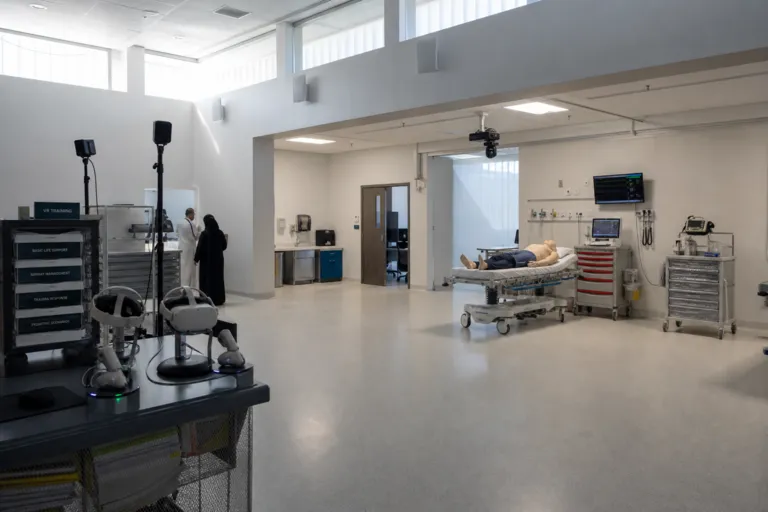
Across healthcare, simulation is increasingly used to build clinical skills without putting real patients at risk. Medical simulation refers to simulated clinical environments and advanced digital tools that help clinicians practice procedures, emergency response, anatomy learning, and communication before they perform in live settings. Market research frames this as part of workforce development and patient safety, with organizations using simulation for standardized education, procedural competency, and operational readiness. This same logic is shaping Saudi medical simulation training, where reforms in medical education and growing use of next-generation tools are steering training time away from bedside-only learning and toward repeatable, measurable practice.
Saudi Arabia-specific commentary in surgical simulation research links momentum to large-scale investments in healthcare infrastructure and medical education reform under Vision 2030. The same source says the government is actively integrating next-generation technologies, including VR and AI-powered simulators, to enhance surgeon training and patient safety. It also describes collaborations among academic institutions, international technology firms, and medical programs as a supporting factor, alongside ongoing work by market players through collaborations, mergers and acquisitions, product approvals, and new product launches. In this context, simulation is positioned as a controlled, risk-free way to practice complex procedures, helping standardize training and support certification and safety priorities.
Global Signals: Growth, Platforms, and What They Imply for Saudi Arabia
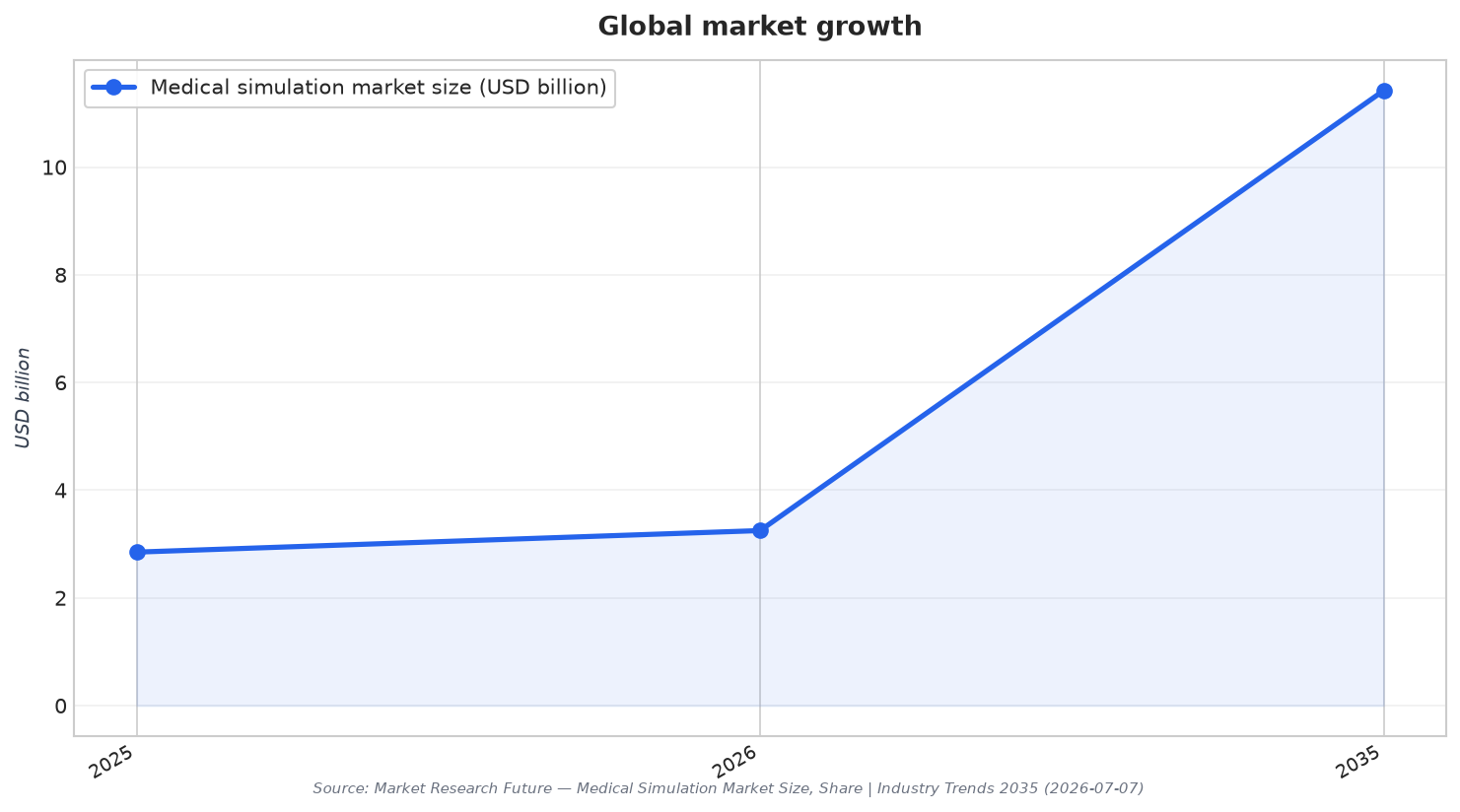
Globally, multiple reports describe fast market expansion and a pivot toward more digital, integrated systems. One report estimates the global medical simulation market at USD 2.58 billion in 2025, projecting USD 8.17 billion by 2035 at a 12.2% CAGR (2026–2035). Another estimates about USD 2.1 billion in 2025 and projects a 16.9% CAGR through 2034, while a third values the market at USD 2.85 billion in 2025 and forecasts USD 11.42 billion by 2035 at a 15.12% CAGR. Differences reflect methodology, but they point in the same direction: higher demand for competency-based training, more software and services, and more immersive tools. For buyers, that is increasingly about ecosystems that bundle software, hardware, analytics, and training services rather than standalone manikins.
Segment-level data helps clarify where budgets are moving. In 2025, one report says hardware products captured 51.2% of global revenue, while low-fidelity simulators held a 47.8% share, acting as an entry point for foundational training. At the same time, services and software are forecast to expand at an 18.95% CAGR through 2035, and another report says simulation software held 26.7% of the global market in 2025. Technology direction is also explicit: one report notes virtual and mixed reality surpassed 32% of advanced simulation deployments, and AI-enabled platforms are projected to expand at a CAGR exceeding 15%. Another report adds that web-based simulation is projected to grow at a 17.5% CAGR, reflecting a shift toward remote training access.
Patient safety is a recurring driver, and some sources offer quantified outcomes from specific studies outside Saudi Arabia that show why the technology is attractive. Grand View Research cites findings from Vantari VR that virtual training reduces medical errors by 40%. It also reports that, in June 2022, the University of Wollongong tested the software and saw a 32% improvement in student clinicians’ performance and a 39% increase in adherence to safety and hygiene protocols. These figures are not Saudi data, but they illustrate why Saudi Arabia’s push for VR and AI simulators can align with goals like safer practice, more consistent assessment, and reduced reliance on limited patient access for learning.
What does medical simulation training mean in practice?
What is driving simulation adoption in Saudi Arabia?
How fast is the global medical simulation market growing?
Which parts of the market are expanding fastest?
How does Saudi medical simulation training connect to VR outcomes reported elsewhere?