Saudi Arabia’s genomics push is moving quickly from ambition to operational capacity. Market estimates point to rapid expansion: IMARC Group’s research cited a Saudi Arabia genomics market size of USD 229.8 million in 2025, with a projection to USD 616.5 million by 2034 at a CAGR of 11.59% during 2026–2034. A separate market view from Ken Research sized the Saudi Arabia Genomics & Precision Medicine Market at USD 215 million in 2025 and projected USD 462 million by 2031, with historical growth averaging 12.60% during 2020–2025 and forecast growth of 13.60% for 2026–2031. These figures reflect demand across sequencing instruments, reagents, tests, bioinformatics, and clinical interpretation, increasingly routed through Riyadh-centered infrastructure.
Public-sector strategy is a major driver, anchored in Vision 2030 and large-scale health innovation investments. One report describes Vision 2030 channeling over SAR 50 billion (USD 13.33 billion) into healthcare innovation infrastructure, positioning genomics as a cornerstone of healthcare transformation. The flagship Saudi Human Genome Program was inaugurated in 2018 and is managed by King Abdulaziz City for Science and Technology. It targets sequencing 100,000 Saudi genomes and is described as having achieved 63,000 sequenced genomes, or 63% completion, to build a national genetic database. The same source links this push to hereditary disease burden, citing hereditary diseases affecting 8% of births and 20% of the population, alongside 56% consanguinity rates.
From National Databases to Localized Clinical Throughput
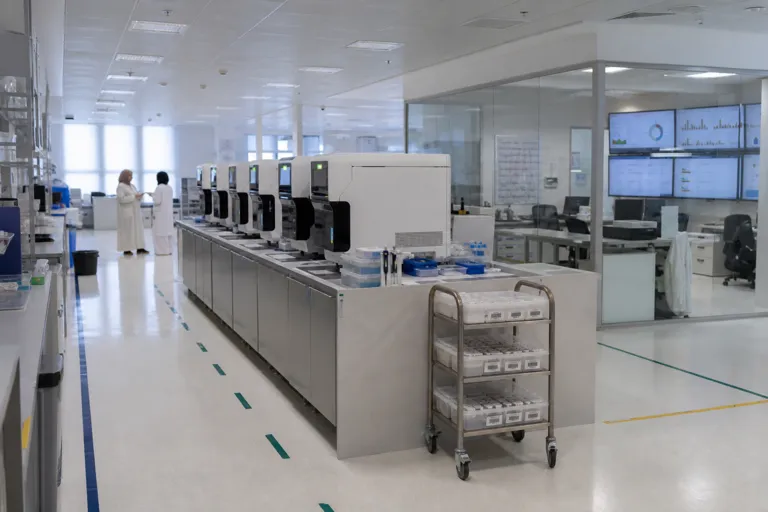
Execution depends on localized labs, procurement scale, and hospital analytics. Ken Research describes Riyadh as the dominant operating hub because national research, tertiary care, procurement, and genomic-data infrastructure are concentrated there. It also notes Genalive’s Riyadh facility spans approximately 4,000 square meters and that King Faisal Specialist Hospital & Research Centre reported a fivefold increase in whole-genome analytical capacity in 2024. On the tender side, one source states BGI Genomics secured a three-year NUPCO contract providing 930,000 genetic testing services across 83 public hospitals, including whole genome sequencing, whole exome sequencing, and hereditary cancer screening. These moves support faster routing and repeat clinical use rather than one-off research projects.
AI-enabled analysis is positioned as the accelerator that turns sequencing into clinical decisions at scale. A report describes AI-powered bioinformatics pipelines at Genalive’s Riyadh facility processing 1,000 genomes monthly, with scaling planned to 5,000 monthly, while reducing variant interpretation time from days to hours and identifying pathogenic mutations with 35% greater accuracy. Another dataset values the Saudi Arabia AI in genomics market at USD 9.5 million in 2025 and expects it to reach USD 132.9 million by 2033; it also states software was the largest segment with a 56.84% revenue share in 2025. In that same dataset, Saudi Arabia accounted for 0.8% of the global AI in genomics market in 2025, underscoring that growth is happening from a relatively small base.
The clinical pipeline is also expected to widen, not just deepen. Ken Research projects clinical genomic tests and precision-care episodes to exceed 1.10 million annually by 2031, compared with approximately 433,000 in 2025. It models local processing rising from 68% to 86%, shifting value away from overseas reference laboratories toward Saudi laboratories, bioinformatics providers, and hospital networks. In parallel, an NGS-focused release values the Saudi Arabia Next Generation Sequencing market at USD 24.4 million in 2023 and describes growing clinical adoption, particularly in oncology, reproductive health, and infectious disease testing. Together, these signals show how the Saudi genomics program ecosystem is being built to generate data, interpret it, and keep more of the workflow inside the Kingdom.
What is the sequencing target for Saudi Arabia’s national genome initiative?
How large is Saudi Arabia’s genomics market, and what are the projections?
What does the Saudi genomics program ecosystem look like in Riyadh today?
How is AI changing genome interpretation in Saudi Arabia?
How many clinical genomic tests could Saudi Arabia run each year by 2031?