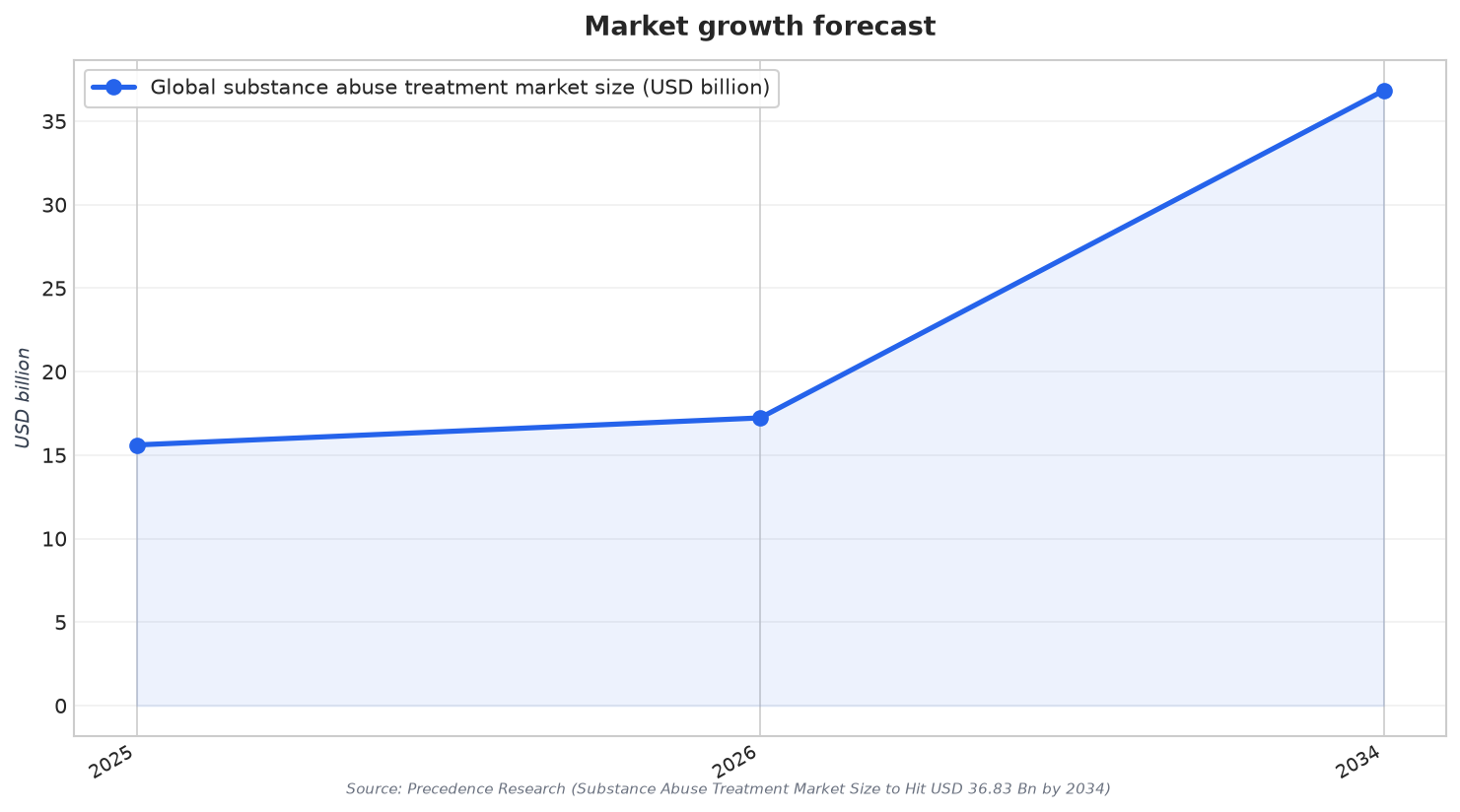
Recovery works best when people are treated as whole human beings, not as a diagnosis. That is why the conversation around Saudi addiction treatment centers is increasingly about dignity, privacy, and integrated care pathways that go beyond detox alone. Market signals show that treatment demand is expanding globally and regionally, and the fastest-growing models are those that connect medical, psychological, and social support in one plan. In the global substance abuse treatment market, Precedence Research estimates USD 15.61 billion in 2025, rising to USD 17.23 billion in 2026 and approximately USD 36.83 billion by 2034, reflecting a CAGR of 10.05% from 2026 to 2034.
Regional context matters, and sources that mention Saudi Arabia place it within a wider pattern of expansion. Verified Market Reports notes a substance abuse treatment market valued at USD 1.4 billion in 2024, expected to grow from USD 1.5 billion in 2025 to USD 2.7 billion by 2033, with a CAGR of approximately 8.2%. The same source states that countries such as South Africa, Saudi Arabia, and the United Arab Emirates are leading regional expansion, driven by rising substance misuse, especially alcohol and synthetic drugs. Dataintelo also observes that GCC nations have developed specialized addiction treatment centers serving domestic and regional patients, while warning that gaps persist in rural and underserved regions.
Integrated Care Is Becoming the Standard, Not the Exception
Integrated care is not a slogan. It is a delivery model that connects medication support, behavioral therapies, and mental health services so patients do not fall through cracks after a short stabilization phase. Market Research Future describes an industry shift toward individualized recovery plans that integrate medication-assisted treatment, behavioral therapies, and mental health services, and it highlights the growing role of telehealth and digital platforms in improving access and adherence. OpenPR similarly points to stronger emphasis on integrating mental health services, dual diagnosis models, and long-term relapse prevention, alongside growing demand for outpatient and aftercare services.
U.S. statistics underline why continuity and integration matter, but they should be read as context, not as Saudi-specific measures. Statpit reports that the number of addiction treatment facilities in the United States was about 14,200 in 2020, and that SAMHSA reported 14,400 opioid treatment program locations in the United States in 2024. Statpit also reports a gap between need and care in the United States: in 2023, 51% of people who needed substance use treatment did not receive any treatment in the past year. These figures illustrate a practical lesson for any system: capacity alone is not enough without navigation, coordinated services, and sustained follow-up.
For Saudi Arabia, the opportunity is to build on regional momentum while prioritizing models that are multidisciplinary and accessible. Verified Market Reports describes integrated care teams that include psychiatrists, addiction specialists, social workers, and primary care providers working collaboratively, and it links integrated approaches to better long-term recovery. Dataintelo adds that clinics and primary care practices captured 21.4% of the distribution channel market in 2025, showing how office-based and community-linked care can expand reach. In practice, the next chapter for care in the Kingdom can focus on seamless transitions across detox, outpatient support, and continuing care, supported by digital tools and stigma-aware service design.
Why is integrated care becoming more important in addiction treatment?
What do the sources say about Saudi Arabia’s role in regional treatment growth?
How can Saudi addiction treatment centers support recovery with dignity?
What do U.S. figures suggest about access gaps that other systems should plan for?