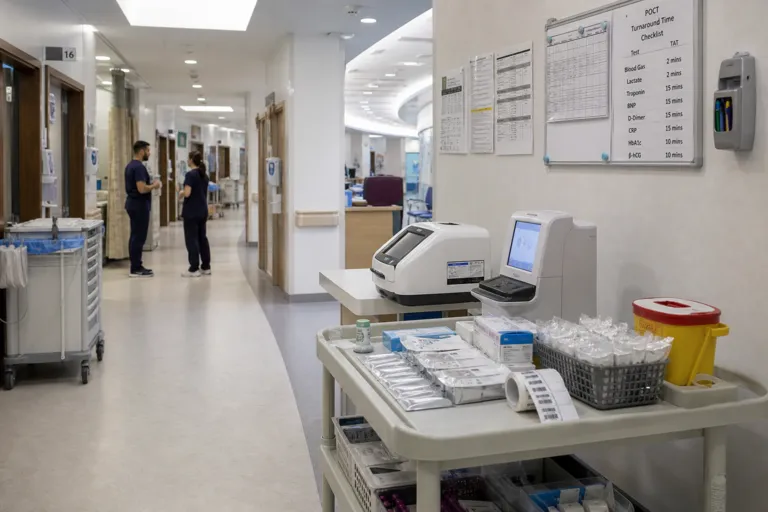
Testing at the bedside is becoming a defining feature of modern healthcare in Saudi Arabia. Rapid diagnostics are increasingly used across healthcare, home testing, and emergency settings, supported by demand for quick and accurate results. Mobility Foresights describes rapid diagnostics as tests that provide results within minutes to an hour, enabling immediate clinical decisions, and notes that factors such as limited laboratory infrastructure in remote areas and the need for efficient patient triage are fostering adoption. In parallel, a separate Saudi market segment focused on point-of-care molecular diagnostics was reported by Grand View Research to generate USD 54.6 million in revenue in 2024, with expectations of reaching USD 98.8 million by 2033, reflecting a projected 7% CAGR from 2025 to 2033.
Multiple market lenses point to sustained momentum. Mobility Foresights projects the Saudi Arabia rapid diagnostics market to grow from USD 4.3 billion in 2025 to USD 8.1 billion by 2031, at a CAGR of 10.7% during that period. Ken Research adds broader context by valuing the Saudi Arabia Independent Diagnostic Testing Facility Market at approximately USD 1.6 billion based on a five-year historical analysis, and explicitly links growth drivers to adoption of point-of-care and home testing alongside advances in diagnostic technologies. Taken together, these sources show how bedside testing is expanding alongside labs and imaging, not replacing them, as healthcare providers pursue faster decision-making and more accessible diagnostic pathways.
What Is Powering Faster Results and Wider Access
Speed is a central advantage of point-of-care approaches, especially when clinical decisions cannot wait. Ken Research reports that traditional diagnostics are projected to have an average turnaround time of around 48 hours, while point-of-care tests can deliver results in under an hour. Saudi Arabia’s push for rapid infectious disease testing is also highlighted by Grand View Research, which notes a strong focus on COVID-19 testing to address pandemic challenges. It cites a May 2021 development by researchers at King Abdullah University of Science and Technology: a new rapid test for COVID-19 detection that offers results within 15 minutes. These examples illustrate why point-of-care workflows fit emergency care and outbreak response, where timing can shape treatment choices and patient outcomes.
Technology and distribution changes are widening where and how tests are used. Mobility Foresights attributes growth to advancements in immunoassay, molecular diagnostics, and biosensor technologies, as well as the introduction of multiplex and portable devices capable of detecting multiple pathogens simultaneously. It also points to expansion of decentralized healthcare systems, a home-based testing culture, and growth in e-health platforms and online distribution channels that broaden reach. Ken Research reports that investments in innovative diagnostic tools are increasing by 15% annually in the Saudi point-of-care molecular diagnostics market context, and it connects telemedicine to diagnostic access, stating that over 60% of the population is now using telehealth services. This creates a practical pathway to integrate near-patient testing into remote care models.
Applications are also shaping the trajectory of Saudi point-of-care diagnostics. Grand View Research segments the country’s point-of-care molecular diagnostics market across oncology, prenatal testing, endocrinology, hematology, infectious diseases, and other applications, and reports that infectious diseases was the largest revenue-generating application in 2024. The same source adds that oncology is expected to be the most lucrative application segment, registering the fastest growth during the forecast period. Meanwhile, Ken Research describes how different test types serve distinct needs across the broader testing ecosystem, with pathology holding the largest share and molecular diagnostics seeing rapid growth. As hospitals, independent testing facilities, and digital health platforms expand, bedside and near-patient testing is positioned to become a routine part of diagnosis and monitoring across settings.
How fast can point-of-care tests deliver results compared with traditional diagnostics in Saudi Arabia?
What is the outlook for Saudi Arabia’s point-of-care molecular diagnostics market?
Which application led point-of-care molecular diagnostics revenue in Saudi Arabia in 2024?
How are telehealth trends linked to point-of-care diagnostics in Saudi Arabia?