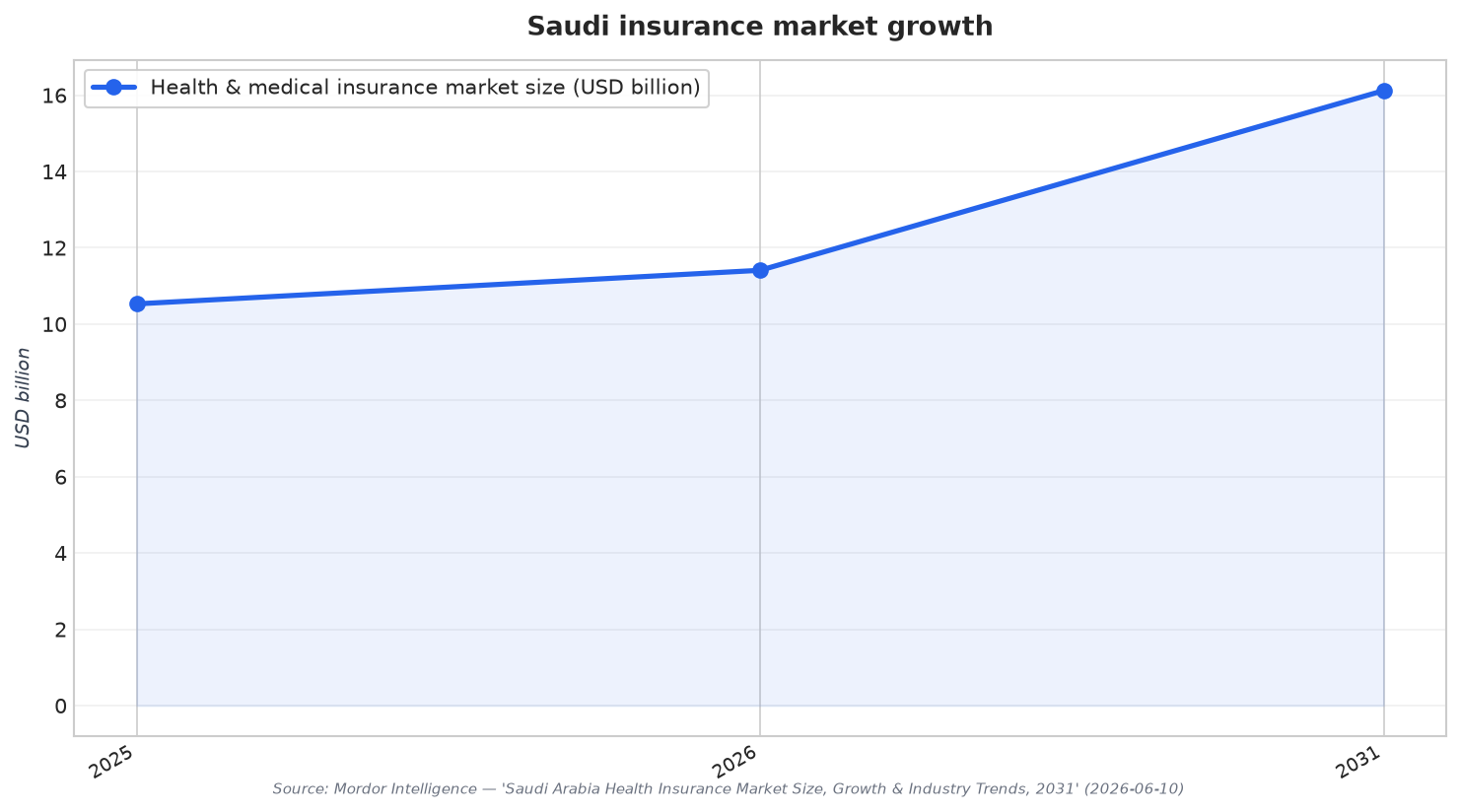
Saudi Arabia’s health and medical insurance market is growing in premium value from USD 10.53 billion in 2025 to an estimated USD 11.41 billion in 2026, with a forecast to reach USD 16.12 billion by 2031 at a 7.16% CAGR. Group health led with 71.33% share in 2025, reflecting how employer-sponsored coverage shapes benefit design and cost control priorities. As comprehensive packages are increasingly broken into modules—such as inpatient, outpatient, and dental—pharmacy benefits can no longer be treated as an afterthought. That is where Saudi pharmacy benefit management starts to look like a practical “missing middle”: a structured way to manage drug coverage decisions inside fast-scaling insurance products.
Digitization is also tightening the operating loop between insurers, providers, and claims. Real-time e-claims through the NPHIES platform are described as improving settlement speeds, lowering denial rates, and reducing working-capital pressures for providers. In parallel, Saudi Arabia’s healthcare claims management market is valued at approximately USD 230 million, and it explicitly segments pharmacy claims management alongside inpatient and outpatient claims categories. This matters because PBM approaches rely on clean, timely utilization and claims signals to run formularies and benefit rules consistently. At the consumer layer, the Sehhaty app has over 24 million users—around 68.5% of the population—showing that prescription management and digital workflows are already familiar touchpoints for millions of members.
What’s Driving PBM Momentum in the Kingdom
Cost pressure and purchasing reform are key parts of the PBM story, and Saudi Arabia has a notable anchor in centralized procurement. Industrial reporting notes that in 2022, healthcare expenditure of the GCC countries crossed the USD 50 billion mark, with drug benefits becoming a salient feature in insurance policies. In Saudi Arabia specifically, the National Unified Procurement Company (NUPCO) is unifying pharmaceutical purchases to realize savings. That creates an environment where payers and purchasers want tighter rules on which drugs are covered, under what conditions, and at what net cost. PBM services—such as developing and managing formularies and implementing cost-saving strategies—fit that need by turning purchasing leverage and benefit design into repeatable operating practice.
Internationally, PBM market data provides context for why these models keep attracting investment and experimentation. One market estimate puts the PBM market at USD 563.96 million in 2022, with a projected 5.29% CAGR during 2023–2028; the same source highlights that PBM managers negotiate with drug makers to secure discounts and pass savings to insurers. A separate example of ongoing pricing innovation came in May 2024, when Optum Rx unveiled a new drug pricing model called Clear Trend Guarantee, positioned to make drug spending more predictable for payers when operating as a PBM. Saudi Arabia’s insurance market is simultaneously being streamlined under consolidated oversight, with a March 2024 regulatory consolidation under the Insurance Authority described as centralizing oversight and streamlining approval cycles—conditions that can accelerate adoption of standardized pharmacy benefit controls.
The “missing middle” is ultimately about aligning incentives across employers, insurers, and provider networks as the insured base diversifies. Large corporates accounted for 58.38% of the Saudi health and medical insurance market share by end-user in 2025, and brokers led distribution with 54.42% share the same year, while digital aggregators are forecast to grow at a 22.38% CAGR through 2031. These channels and buyer types tend to demand clearer reporting and predictable benefit outcomes. PBM-style administration—formulary management, plan design consultation, and pharmacy claims oversight—helps translate broad cost pressures into specific coverage rules. The result is a more controlled pharmacy benefit inside a market where outpatient claims process the highest volume and inpatient absorbs the largest share of disbursements, making overall utilization management central to insurer performance.
Why is pharmacy benefit management gaining attention in Saudi health insurance?
What role does NPHIES play in making PBM approaches more viable?
How does Saudi procurement policy connect to PBM-style cost control?
What signals show Saudi members are ready for more digital pharmacy workflows?
How can Saudi pharmacy benefit management fit employer-led coverage?