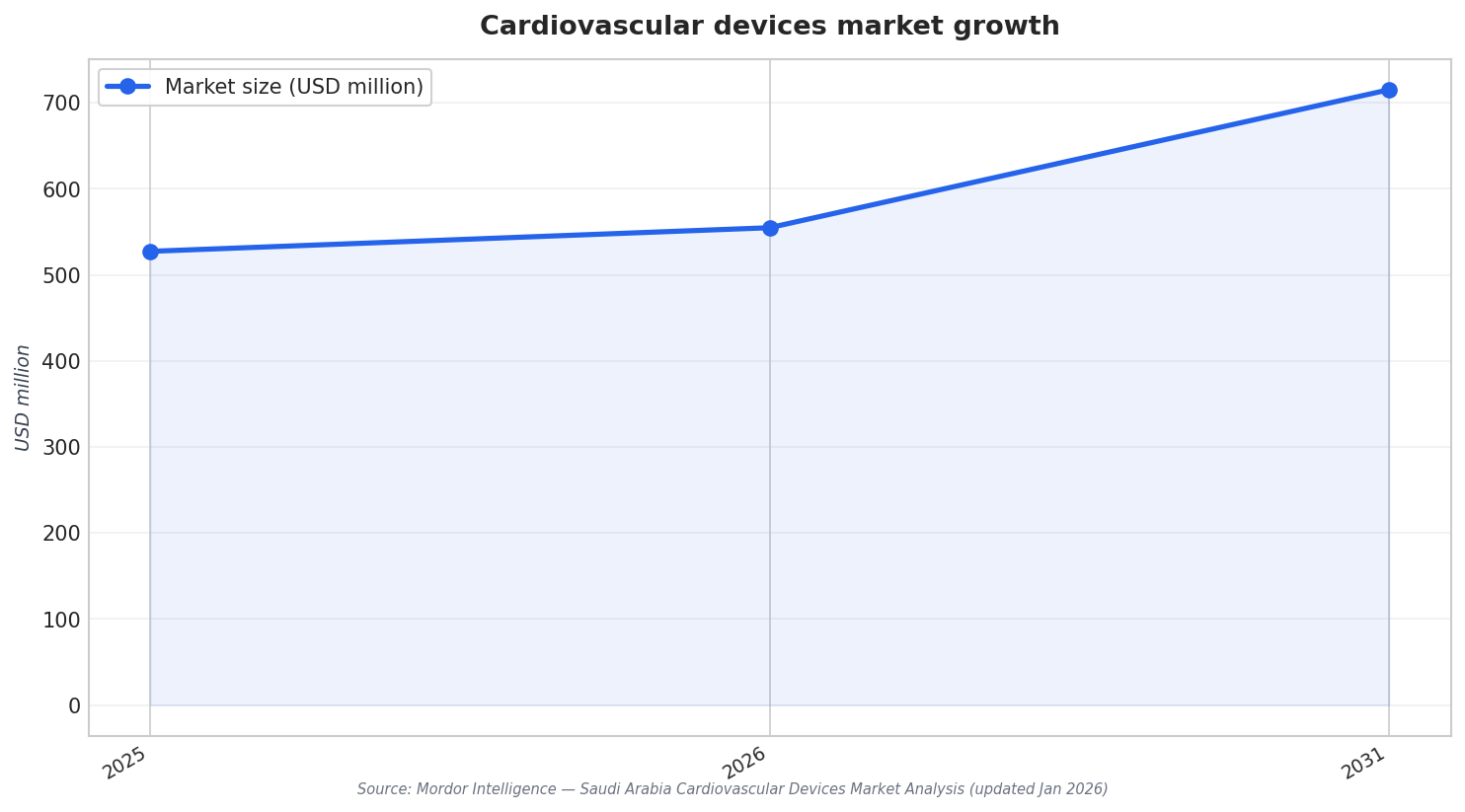
Saudi Arabia is building a broader base for cardiovascular care, from procedure capacity to monitoring and follow-up. Mordor Intelligence projects the Saudi Arabia cardiovascular devices market to expand from USD 527.33 million in 2025 and USD 554.80 million in 2026 to USD 715.19 million by 2031, registering a CAGR of 5.21% between 2026 and 2031. The same analysis links this expansion to a pivot toward preventive cardiology under Vision 2030, including a USD 65 billion health-care envelope aimed at modernizing catheterization laboratories, hybrid operating rooms, and virtual-care hubs. Within this shift, access dynamics also matter. Mordor Intelligence notes that mandatory employer-funded insurance is widening access to transcatheter therapies and home-based monitoring.
The clinical need behind this buildout is described as a dual epidemic. Mordor Intelligence states that cardiovascular disease accounts for more than 45% of deaths in Saudi Arabia, while diabetes prevalence stands at 23.1% among adults. It also cites a forecast of diabetes prevalence reaching 9.5 million adults by 2050 (International Diabetes Federation, IDF Diabetes Atlas 10th Ed). These dynamics influence what “capacity” means in practice: coronary stent cases are increasingly supported by intravascular ultrasound to optimize deployment in calcified lesions common in diabetic vessels, and heart-failure clinics rely on cardiac resynchronization devices and pulmonary pressure sensors. Screening efforts are also evolving, with National Transformation Program screening targeting people aged 40–60.
What Growth Looks Like Across Devices, Settings, and Supply Chains
In the Saudi cardiac care market, growth is not uniform across product categories and care settings. Mordor Intelligence reports therapeutic and surgical devices led with 64.20% of Saudi Arabia cardiovascular devices market share in 2025, while diagnostic and monitoring devices are projected to post the fastest 5.93% CAGR to 2031. By application, coronary artery disease accounted for 48.50% of the market in 2025, while structural heart disease devices are expected to expand at a 6.45% CAGR through 2031. Care delivery is also shifting. Hospitals accounted for 68.20% of revenue share in 2025, yet home care settings are forecast to grow at a 6.71% CAGR through 3031.
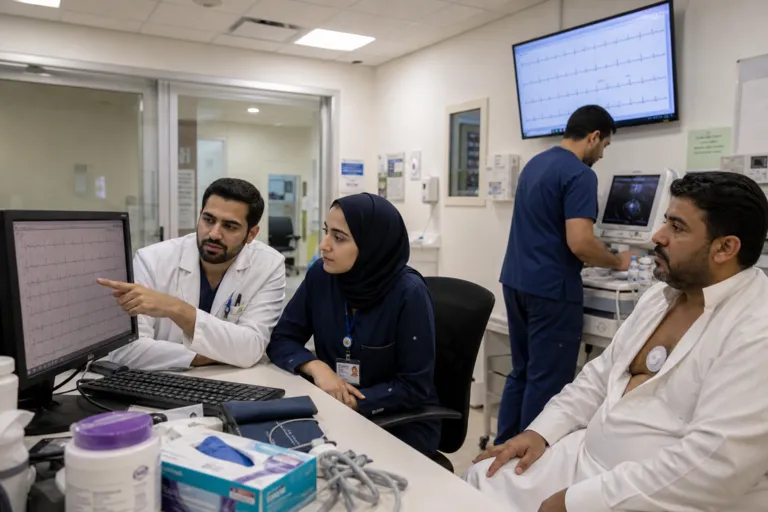
Digital tools are becoming a parallel track for capacity expansion, especially for monitoring, adherence, and remote follow-up. Grand View Research reports that the Saudi Arabia digital health for cardiovascular market generated revenue of USD 190.0 million in 2024 and is expected to reach USD 673.7 million by 2030, and it calls Saudi Arabia the fastest growing regional market in Middle East and Africa. The same source ties adoption to increasing smartphone penetration and better network coverage. Mordor Intelligence adds another demand signal by noting rapid uptake of AI-enabled arrhythmia analytics that is cutting 30-day readmissions. Taken together, these trends support a model where capacity is not only beds and labs, but also software, services, and home-based monitoring programs.
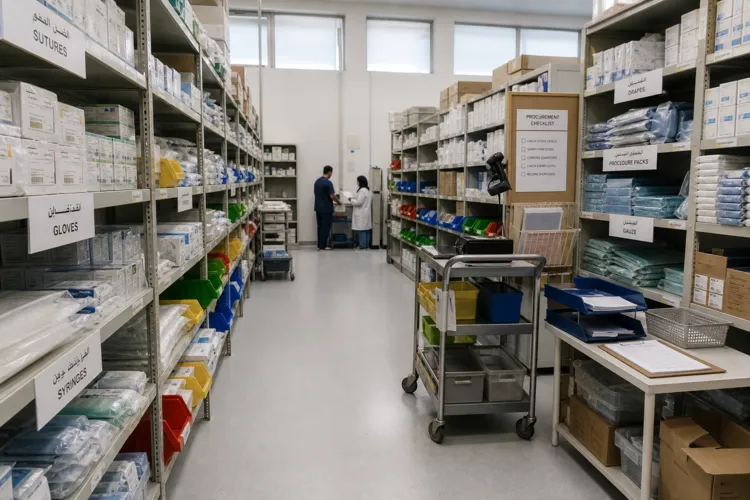
Localization and procurement models are reshaping how cardiovascular capacity is supplied. The U.S. International Trade Administration notes that under Vision 2030, Saudi Arabia is prioritizing local production, technology transfer, local clinical trials, and training for the Saudi labor force, and it aims to increase private sector contribution from 40% to 65% by 2030, targeting privatization of 290 hospitals and 2,300 primary health centers. It also reports that during 2021, Saudi Arabia spent 25% to 35% of the total healthcare budget on diabetes, obesity, and cardiovascular diseases. On the device side, IndexBox reports that imported standard diagnostic catheters continue to dominate, accounting for an estimated 85%–90% of total consumption, while domestic manufacturing remains nascent but is expected to grow as the Kingdom pursues its medical device localization strategy.
How fast is Saudi Arabia’s cardiovascular devices market expected to grow?
Which device categories lead and which are growing fastest?
What is driving demand in the Saudi cardiac care market?
How large could Saudi Arabia’s digital health for cardiovascular segment become?
How dependent is Saudi Arabia on imported diagnostic catheters?