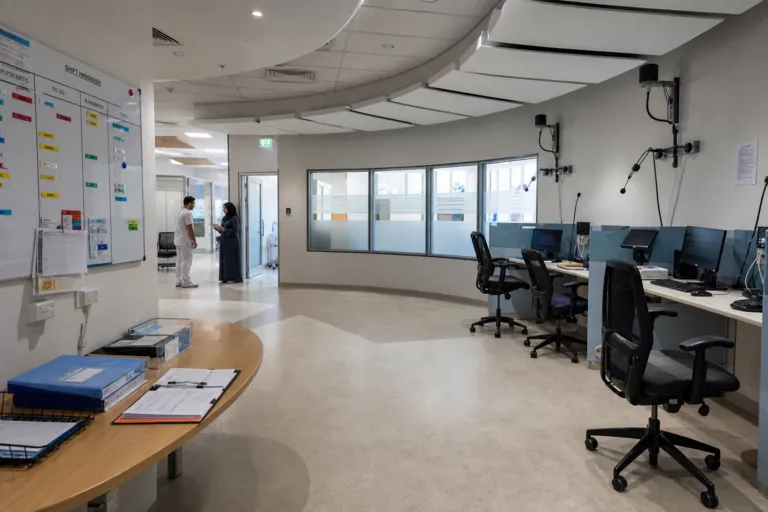
Clinical documentation has long been a bottleneck for healthcare. New ambient AI tools are designed to listen during the visit and produce structured notes that can be filed into EHR systems. Market research describes AI medical scribe software as using natural language processing (NLP), large language models (LLMs), and ambient voice-capture to automatically transcribe, structure, and file encounter notes into EHRs. That same source frames the demand driver clearly: documentation burden and the need to reduce administrative time without compromising record quality. In Saudi Arabia, operational AI is already being positioned as a way to shrink documentation load through NLP and virtual assistants, so clinicians can spend more time at the bedside and less time on paperwork.
Globally, the market trajectory shows why hospital leaders are paying attention. One report values the global AI medical scribe software market at USD 2.8 billion in 2025 and projects USD 14.6 billion by 2034, with a 20.2% CAGR over 2026–2034. A separate analysis estimates the AI clinical documentation (ambient scribe) market at USD 1.2 billion in 2025 and projects USD 15.1 billion by 2035, growing at a 28.8% CAGR over 2026–2035. These figures are global context, not Saudi-specific performance, but they signal how quickly ambient documentation is moving into mainstream procurement. That growth story is tied to workflow impact: early deployments cited documentation time reductions of 50% to 72%, and some platforms reported clinicians reclaiming as many as 3.2 hours per day previously consumed by charting.
Why Saudi Hospitals Are Leaning Into “Invisible” Documentation
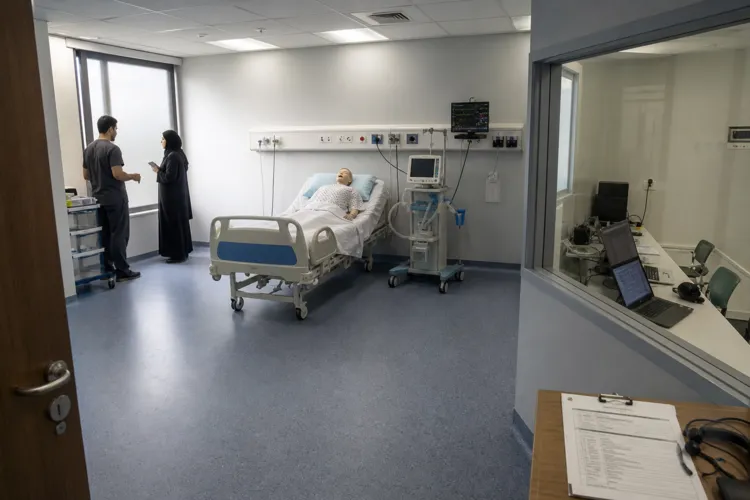
Regional infrastructure choices are also shaping adoption. A market press release states that newly constructed mega-hospitals in the UAE and Saudi Arabia are embedding ambient AI directly into exam-room architecture “from day one,” positioning a paperwork-free environment as a recruitment incentive for foreign physicians. The same source describes these sovereign wealth-funded systems as aggressive partners to both tech giants and startups, acting as gatekeepers for what succeeds inside modern hospital walls. This design-led approach matters because it can reduce friction: instead of asking clinicians to learn yet another interface, the “ultimate goal” described is an ambient scribe that becomes effectively invisible. This narrative aligns with the broader push for operational AI in Saudi hospitals, where NLP tools are framed as a practical path to reclaim clinician time.
Evidence from outside Saudi Arabia helps clarify what “good” can look like, while also underscoring where proof is still developing. Medical Economics reports that as of 2026, 70% of physicians in the UCSF health system were using AI scribes in daily practice. It also reports that at Kaiser Permanente, 7,260 physicians used AI scribes in more than 2.5 million patient encounters over 14 months ending in December 2024. At the same time, the article notes that JMIR AI (October 2025) screened more than 1,400 studies on ambient scribes and found only six that met rigorous criteria for real-world evidence. That mix of fast adoption and still-thin evidence is the reality Saudi decision-makers must weigh as they scale clinical documentation programs.
For hospital operators, the case often blends clinician experience, patient experience, and economics. One ambient scribe market analysis reports physicians spend 5.8 hours in the EHR for every eight scheduled clinical hours, with documentation alone consuming 2.3 hours. It also cites outcomes from deployments and studies, including 15,791 hours of total documentation time saved (equal to 1,794 eight-hour workdays) and a burnout change from 51.9% to 38.8% after 30 days, with 74% lower odds of burnout. Patient experience improvements are also cited, with Press Ganey scores increasing by 0.9 to 1.9 points after adoption. Against this backdrop, the cost side matters: Medical Economics notes enterprise tools with deep EHR integration can cost several hundred dollars per clinician per month, often with multiyear contracts. For Saudi AI clinical documentation strategies, the practical next step is matching these global learnings to local workflows, governance requirements, and EHR integration plans.
What is ambient AI documentation in hospitals?
Are Saudi hospitals already adopting ambient AI scribes?
What global adoption signals suggest this will become routine clinical practice?
What does the research say about clinician time and burnout impacts?
How should Saudi Arabia’s AI-driven clinical documentation be evaluated safely?