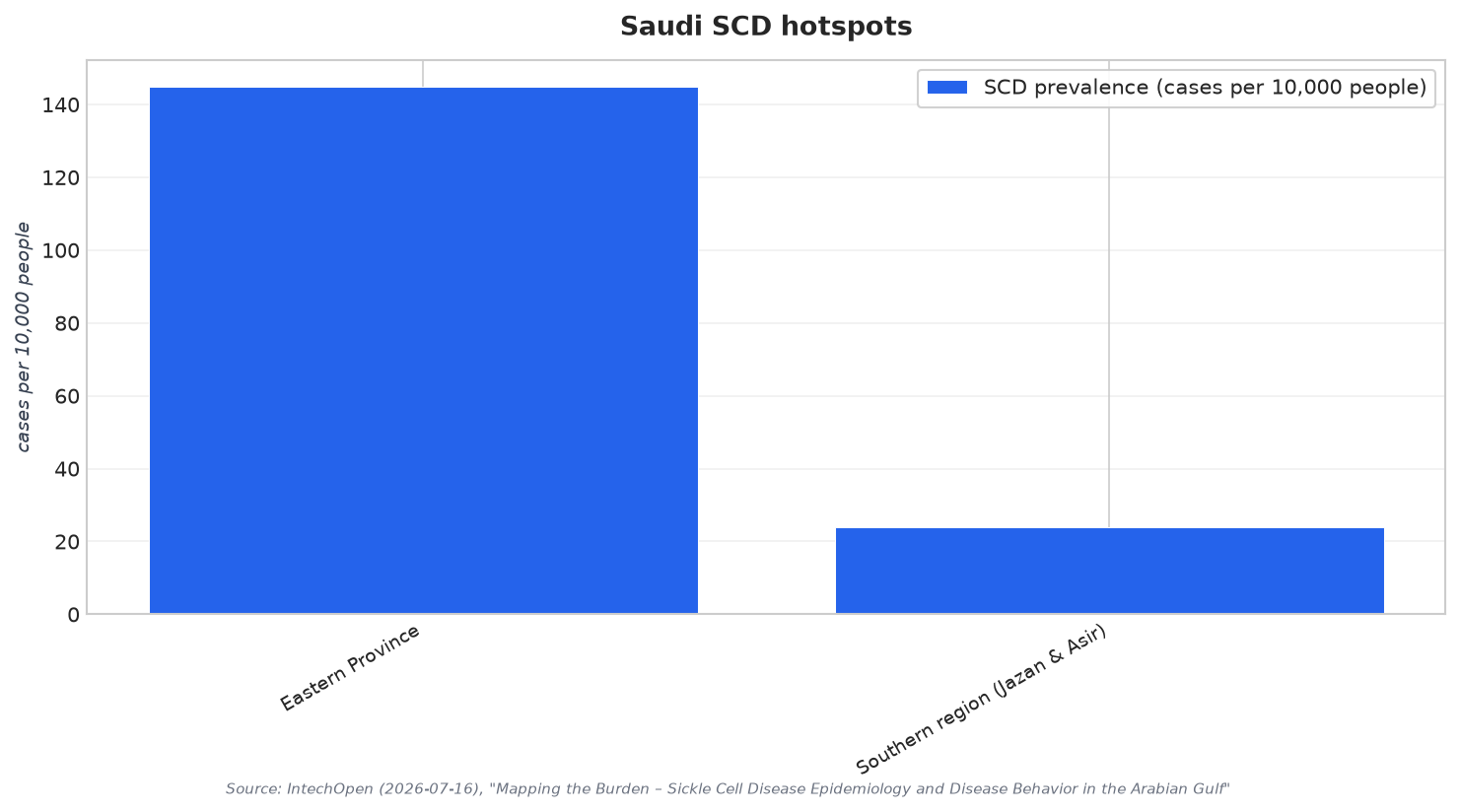
Sickle cell disease (SCD) is described as a significant public health concern in the Kingdom of Saudi Arabia, with a substantial proportion of the population affected in Jazan. Evidence from across the Arabian Gulf also shows wide geographic variation in burden. A systematic assessment cited in a regional perspective chapter reports that the incidence of SCD in the Arabian Peninsula ranges from 1.2% to 2.6%, with the largest burden in Saudi Arabia’s Eastern Province. That same source notes a prevalence of 145 cases per 10,000 people in the Eastern Province, with carrier rates reaching up to 27% in some places, while the Southern region (Jazan and Asir) ranks as the second-highest endemic area with a prevalence of 24 cases per 10,000 population. These differences matter because they shape where patients cluster and where pathways break first.
Recent local data from Jazan helps translate “burden” into lived experience. A cross-sectional observational study in Jazan surveyed 110 individuals with SCD who were seeking medical services in various hospitals. Participants had a mean age of 28.43 ± 9.66 years, 55.5% were male, 4.5% were non-Saudi, and 62.7% were single, with a little less than half residing in cities. Employment was low (36.4%). More than half reported high out-of-pocket expenditures, and transportation was the largest expense at SAR 828.51 ± 925.84 (USD 220.94 ± 246.89) per month. Within this study sample, higher spending burden was associated with poorer physical health (p < 0.001), linking access friction directly to patient well-being.
Where Care Pathways Falter: Costs, Communication, and Continuity
Better Saudi sickle cell disease care requires more than adding services; it requires aligning what patients face with how care is delivered. In Jazan, psychological distress was significantly associated with age (p = 0.008) and marital status (p = 0.001), and married individuals were more distressed. Social scores were lower among those experiencing distress (p = 0.006), while physical health (p < 0.001) and pain scores were higher (p < 0.001). Patients also reported disruption in social interactions and work life, compounded by a lack of family support. Just as important for pathway design, a majority felt their physicians lacked empathy and did not discuss treatment goals, and half avoided visits due to fear. These are not abstract issues; they can shift when and where patients seek help.
Treatment patterns and utilization drivers add another layer for pathway reform. In Jazan, hydroxyurea was the most commonly used therapeutic option (81.8%), while use of newer agents such as L-glutamine and crizanlizumab was limited. Separately, a Saudi Arabia-wide retrospective observational study in children with SCD used the King Abdullah International Medical Research Center (KAIMRC) database across all regions and relied on ICD-10 codes for sickle cell disorders (D57), including sickle cell crises (D57.0) and sickle cell without crises (D57.1), to examine factors associated with inpatient, outpatient, and emergency department visits. Together, these sources point to a pragmatic national agenda: define region-sensitive pathways, track utilization consistently, and connect medication strategy with structured follow-up.
A national priority should not erase regional differences; it should operationalize them. The Eastern Province carries the largest burden reported in Gulf-wide assessments, while Jazan and Asir are consistently described as the second-highest endemic area. That reality suggests a tiered pathway approach: stronger local access supports where travel costs are high, multidisciplinary surveillance to manage chronic organ involvement as emphasized in Gulf-focused perspectives, and patient-centered communication standards that include explicit discussion of treatment goals. The Jazan findings highlight a simple truth: when patients perceive limited empathy or avoid visits due to fear, even a publicly funded system can still struggle to convert availability into timely, trusted care.
What do recent sources say about the regional burden of SCD in Saudi Arabia?
What did the Jazan study find about out-of-pocket costs for people with SCD?
How common was hydroxyurea use among surveyed SCD patients in Jazan?
What patient experience issues can affect Saudi sickle cell disease care pathways?
How are Saudi researchers studying healthcare utilization in children with SCD?