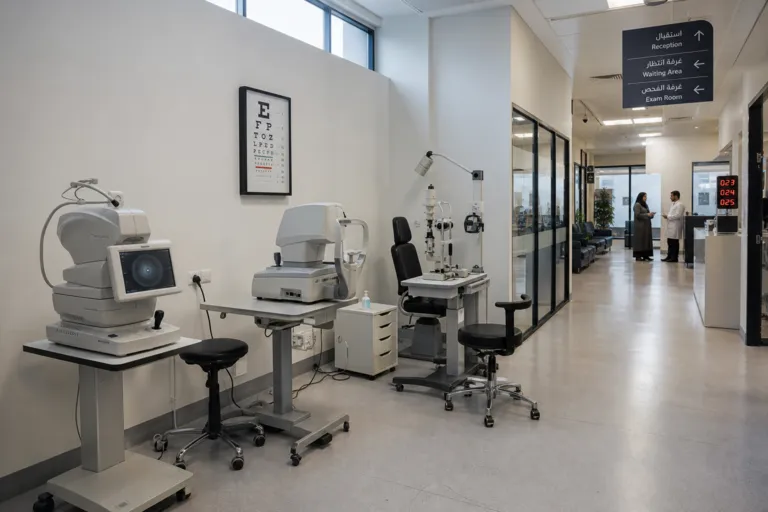
Eye care is becoming a more visible part of everyday healthcare across Saudi Arabia. Market forecasts point to sustained momentum, with Grand View Research projecting the Saudi Arabia eye care market to grow at a 3.5% CAGR from 2024 to 2030 and to reach USD 809.2 million by 2030. In the broader vision care space, Renub Research estimates the Saudi Arabia vision care market will rise from US$ 899.58 million in 2024 to US$ 1,292.62 million by 2033, reflecting a 4.11% CAGR from 2025 to 2033. Together, these outlooks frame an expanding service and product landscape where more patients expect routine exams, faster diagnosis, and a wider menu of treatment options.
Product mix is also shaping where providers invest and how consumers buy. Grand View Research notes that contact lenses were the largest revenue-generating product segment in 2023 within the Saudi Arabia eye care market, while ocular health products are identified as the most lucrative segment and the fastest growing during the forecast period. In parallel, broader industry reporting links growth to rising demand for premium vision correction solutions and expanding partnerships between healthcare providers and international ophthalmic companies, which can improve the availability of advanced diagnostic and surgical services. These dynamics matter because they connect retail choices, clinical workflows, and technology adoption in a single care continuum.
What Is Driving Demand for Eye Care Services in Saudi Arabia?
Several sources point to lifestyle and demographic changes that are pushing more people into eye clinics and optical centers. Commentary on the Kingdom’s vision care sector highlights increasing digital device usage and extended screen exposure as a factor linked to complaints such as digital eye strain, dry eyes, headaches, and blurred vision, alongside growing demand for prescription eyeglasses, contact lenses, blue-light filtering lenses, artificial tears, and specialized eye examinations. The same reporting also describes an aging-related shift, where age-associated conditions such as cataracts, glaucoma, diabetic retinopathy, and macular degeneration become more common. This mix of routine discomfort and chronic disease management supports both preventive screening and specialized ophthalmology services.
Technology adoption is another visible layer of growth. Bonafide Research projects the Saudi Arabia vision care devices market to grow over 6.3% from 2026 to 2031, tying the outlook to an aging population and rising eye health awareness. The report also states that Saudi Arabia’s ophthalmic sector has seen substantial growth in advanced eye care services across hospitals, specialty clinics, and optical centers in major cities, supported by healthcare infrastructure that spans routine checks through complex surgical interventions. On the procurement side, it notes that hospitals and clinics emphasize precision, reliability, interoperability with clinical systems, training support, and long-term operational efficiency when selecting equipment.
Looking ahead, the Saudi ophthalmology market story is less about a single product and more about system-wide capacity. Renub Research describes healthcare transformation under Vision 2030 as improving access to specialized medical services, including ophthalmology, across public and private healthcare facilities, while also emphasizing modernization efforts that expand private-sector participation. Meanwhile, regional industry analysis highlights government initiatives focused on health awareness and investment in modern diagnostic tools and surgical equipment, plus the entry of international brands offering solutions such as contact lenses and prescription glasses. For patients, that combination can translate into more touchpoints for early diagnosis, more treatment pathways, and a deeper set of options as demand continues to rise.
What growth rate is forecast for Saudi Arabia’s eye care market through 2030?
How large could Saudi Arabia’s vision care market become by 2033?
Which product segment led revenue in 2023, and which is expected to grow fastest?
What is the outlook for the Saudi Arabia vision care devices market?
What is changing in the Saudi ophthalmology market in terms of services and access?