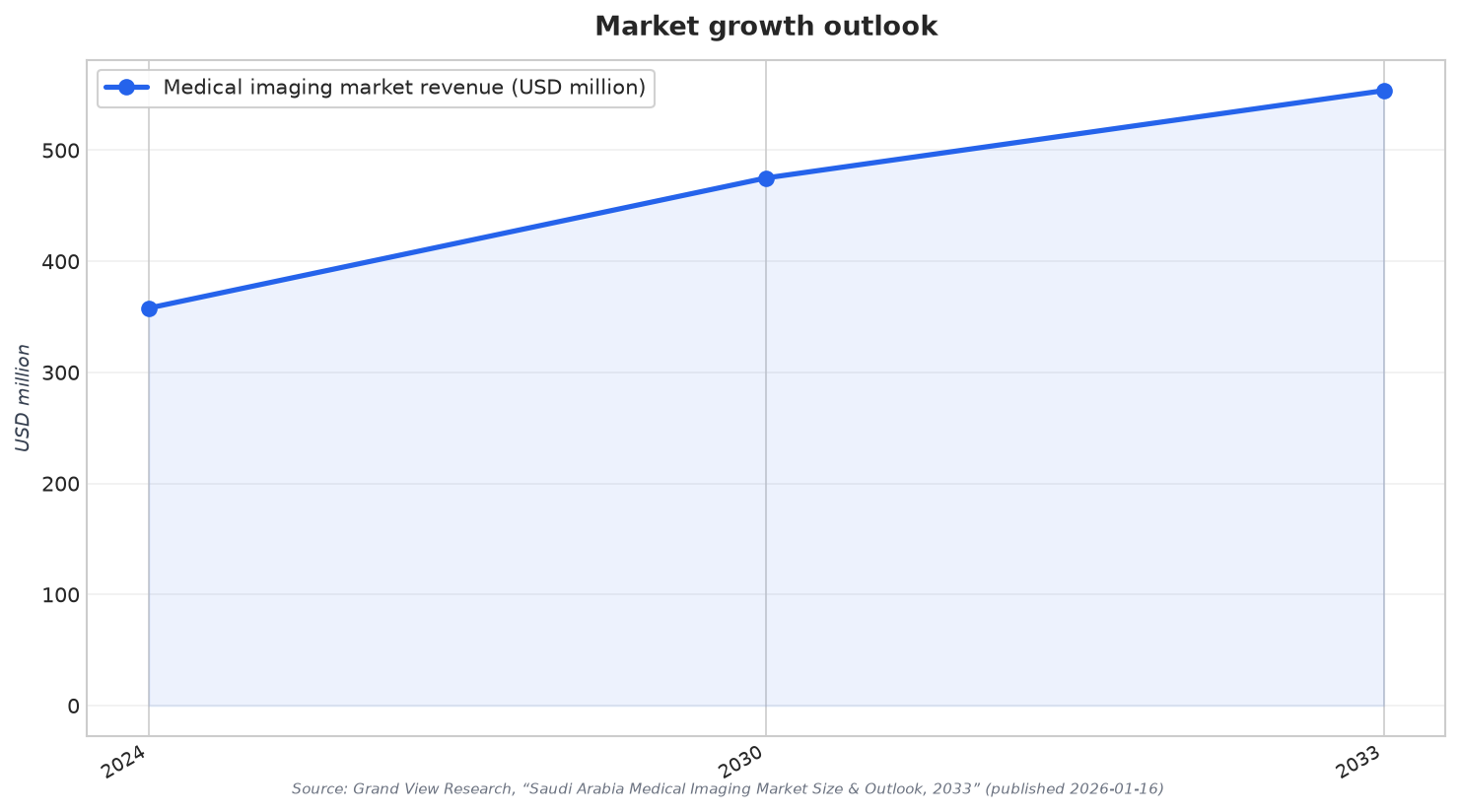
Saudi Arabia’s imaging landscape is widening across equipment, digital infrastructure, and specialized services. Grand View Research estimates the country’s medical imaging market generated USD 357.9 million in 2024 and is expected to reach USD 475.1 million by 2030, with a projected 5.1% CAGR from 2026 to 2033 and a projected US$ 553.7 million by 2033. Reed Intelligence presents a larger sizing view, valuing Saudi Arabia’s medical imaging market at USD 652.52 million in 2024 and projecting USD 1001.58 million by 2033, at a 4.93% CAGR for 2025–2033. These differences underline how definitions and coverage can vary by publisher, but both sources frame a market that continues to scale rather than stall.
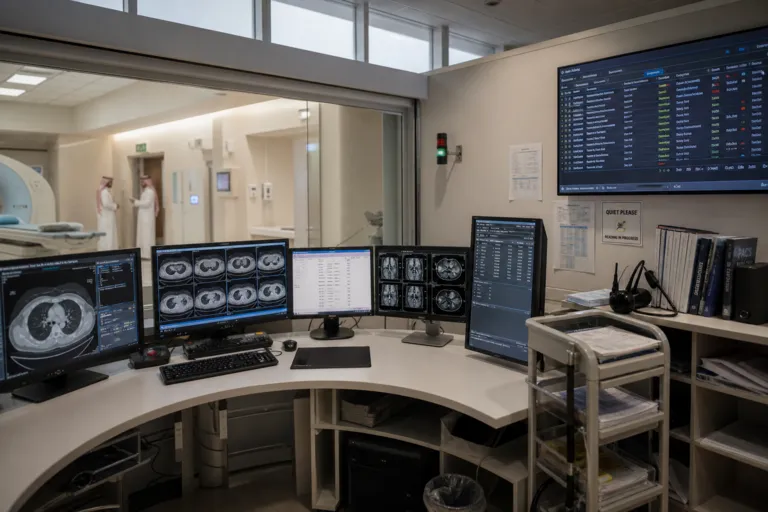
Within the broader equipment picture, Mordor Intelligence estimates the Saudi Arabia diagnostic imaging equipment market at USD 419.11 million in 2025 and USD 439.97 million in 2026, with a projection of USD 560.97 million by 2031, growing at a 4.98% CAGR over 2026–2031. The same source ties demand to system-level transformation, citing Vision 2030, privatization of public hospitals, and higher-resolution modality demand. It also notes an 84,000-bed capacity goal and describes image-exchange networks and virtual hospital initiatives that link 224 facilities to central radiology hubs, which can increase scan volumes by improving access to interpretation and coordinated workflows.
Where the Growth Concentrates: Modalities, Digital Systems, and Workflow
Segment details show how spending concentrates across modalities and care settings. Mordor Intelligence reports that X-Ray led the diagnostic imaging equipment market with a 28.72% revenue share in 2025, while Ultrasound is forecast to post a 6.62% CAGR through 2031. Fixed systems accounted for 80.22% of market size in 2025, while mobile and hand-held systems are projected at a 6.18% CAGR over 2026–2031. By application, oncology held a 29.65% market share in 2025, while cardiology is set to grow at a 5.96% CAGR to 2031. By end user, hospitals retained 64.30% share in 2025, while diagnostic imaging centers are expected to expand at a 6.32% CAGR during the forecast period.
Digital imaging systems provide another window into how providers modernize radiology operations. Grand View Research estimates Saudi Arabia’s medical digital imaging system market generated USD 290.0 million in 2024 and is expected to reach US$ 385.0 million by 2030, with a 4.9% CAGR from 2025. Hardware was the largest segment, with a 63.86% revenue share in 2024, highlighting the continued importance of installed base, upgrades, and acquisition cycles as facilities standardize capture and storage. The same source adds that Saudi Arabia accounted for 0.8% of the global medical digital imaging system market in 2024, which offers context on the country’s footprint in worldwide digital imaging spend.
Service-led growth is even sharper in remote interpretation and outsourcing. A Renub Research estimate reported via Vocal Media projects Saudi Arabia’s teleradiology market to reach US$ 263.93 million by 2033, rising from US$ 100.46 million in 2024, at an 11.33% CAGR from 2025 to 2033. Grand View Research similarly estimates Saudi Arabia’s medical imaging outsourcing market generated USD 65.3 million in 2024 and is expected to reach USD 121.2 million by 2030, growing at an 11.2% CAGR from 2025 to 2030; MRI was the largest revenue-generating product in 2024, with a 32.92% revenue share. Together, these trends show that scaling reading capacity and specialized workflows can expand alongside equipment procurement, especially as networks connect more sites to centralized expertise.
What is the outlook for Saudi Arabia’s medical imaging market through 2033?
How large is Saudi Arabia’s medical digital imaging system market, and what leads it?
Which diagnostic imaging segments lead in Saudi Arabia by share and growth?
How fast are teleradiology and imaging outsourcing growing in Saudi Arabia?