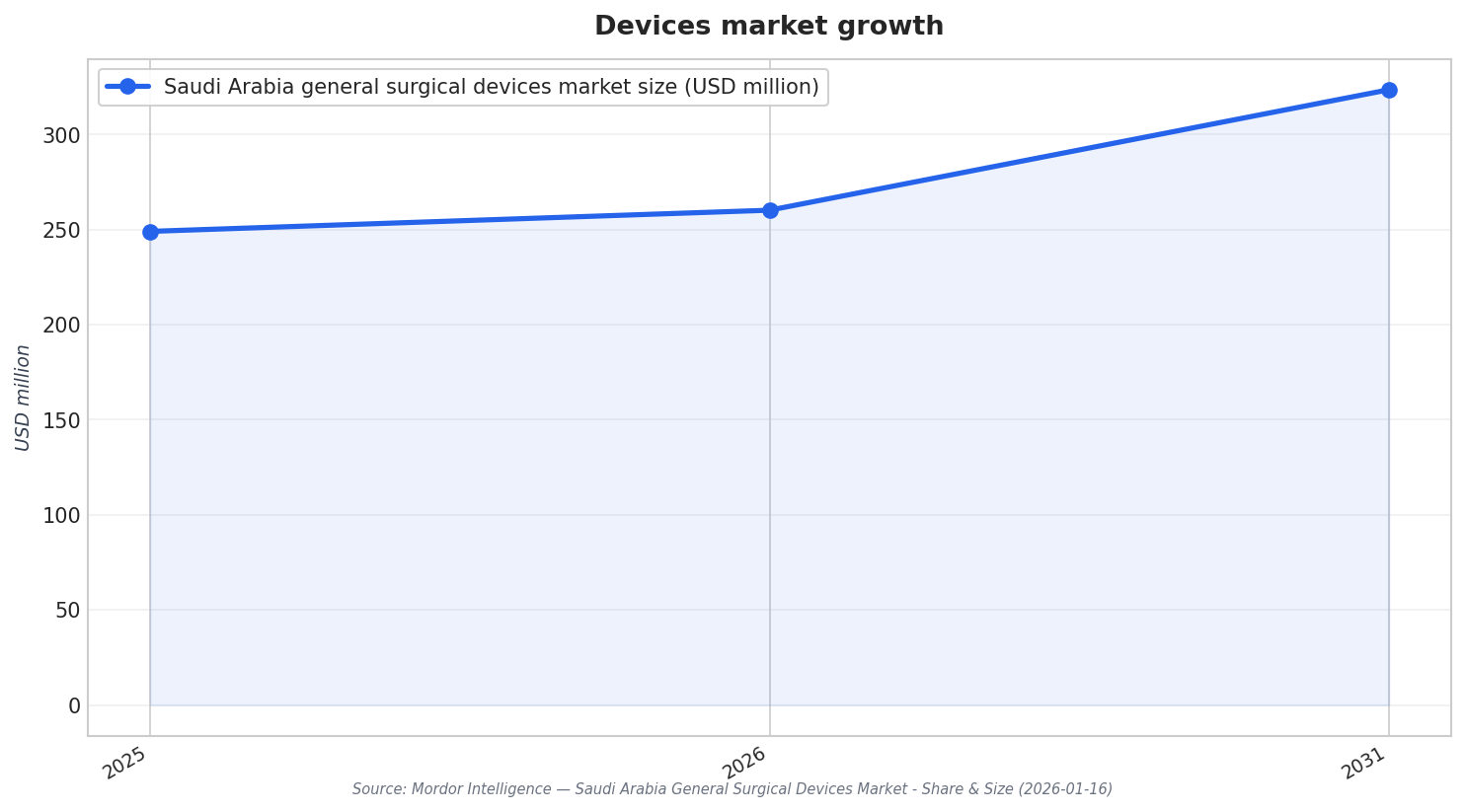
Day-surgery is moving from a niche option to a practical operating model in Saudi healthcare. In the Saudi Arabia general surgical devices market, ambulatory surgical centers are projected to post the highest CAGR among end users at 6.78% through 2031, signaling faster growth than other care settings in that category. The same report frames this momentum alongside large-scale system investment under Vision 2030, noting that more than USD 65 billion has been earmarked for healthcare infrastructure and that 65% of care delivery is set to transition to private operators. Demand for surgical services also remains structural: surgery accounted for 24.7% of all medical referrals in 2024 (Saudi Ministry of Health, Statistical Yearbook 2024), reinforcing the need for more flexible, high-throughput care models.
Clinical mix and operational intensity are also pushing more procedures into settings designed for same-day discharge. Mordor Intelligence reports that major facilities in Riyadh and Jeddah logged 15% to 20% annual increases in trauma surgeries in 2024, contributing to ongoing utilization and replacement cycles for core instruments. In parallel, minimally invasive and robotic approaches are described as fast-growing adoption areas, aligning with patient preference for shorter recovery and the broader push for efficiency. For suppliers, that means procurement patterns increasingly track outpatient-ready workflows, where standardized trays, rapid turnover, and consistent sterilization processes support predictable volumes.
What’s Fueling the Ambulatory Shift in Saudi Arabia
Adjacent categories underline how outpatient sites are gaining purchasing power. In the Saudi Arabia hospital supplies market, hospitals held 64.38% of spending in 2025, but clinics and ambulatory centers are expected to grow at the fastest rate at a 6.75% CAGR during the forecast period. Within that same market, surgical and trauma care led applications with a 37.73% revenue share in 2025, reflecting how procedure-heavy service lines drive consumption of sutures, drapes, and operating-room staples. The report also ties ambulatory expansion to privatization dynamics, supporting the view that operational scale and private management can accelerate day-surgery adoption when paired with consistent supply and training.
Recent investments provide a concrete example of how capabilities are being built for same-day pathways. In March 2025, Alcon launched the first Alcon Experience Center in the Middle East and Africa in Jeddah, described as a SAR 25 million (USD 6.7 million) training hub for ophthalmologists on phacoemulsification systems and premium intraocular lenses, with the stated effect of accelerating adoption of same-day cataract surgery in ambulatory settings. Procedure economics also shape site-of-care decisions. Ken Research notes that myomectomy costs in Saudi Arabia can range from SAR 25,000 to SAR 55,000 depending on complexity and type, a barrier that can influence how providers design efficient, minimally invasive care pathways where appropriate.
Regional and global context helps frame how Saudi ambulatory surgery centers fit into broader outpatient expansion, without treating foreign figures as local outcomes. Precedence Research projects the Middle East endoscopy and ambulatory surgical center market to grow from USD 66.66 billion in 2025 to USD 96.79 billion by 2035 at a 3.80% CAGR, and reports that ambulatory surgical centers represent 33% of end-user share in 2025 within that regional dataset. Separately, a global perspective from Towards Healthcare states that the ambulatory surgical centers market was USD 105.58 billion in 2024 and is predicted to reach USD 183.1 billion by 2034 at a 5.66% CAGR, while also stating that over 80% of surgeries are conducted in an outpatient setting. For Saudi stakeholders, these comparisons reinforce the direction of travel: more cases, more technology, and more day-surgery capacity built into modern care delivery.
Why are day-surgery models expanding in Saudi Arabia?
What growth signals point to Saudi ambulatory surgery centers gaining momentum?
What recent investment supports same-day surgery capability in Saudi Arabia?
How do trauma volumes relate to outpatient surgical planning?
What do regional benchmarks suggest about outpatient care’s direction?